.LONG TERM...
(Wednesday morning through next Sunday)
Issued at 149 PM EST Mon Jan 5 2026
Model agreement on the
front end of the forecast will quickly fall
apart as we
head into the long term portion of the forecast.
Wednesday will see the quick hitting
upper level system that swung
by the area depart and be replaced by
upper level ridging with
subtropical connections. The temperatures on Wednesday and Thursday
will be quite warm for early January (even by Georgia standards).
Highs each day will be in the upper 60s to mid 70s across north and
central Georgia. This will be anywhere from 15-25 degrees above
normal for this time of year. We might make a run at a handful of
record highs, especially at Atlanta where our record highs sit in
the lower 70s most days this week. Overnight lows will stay warm
thanks to relatively moist airmass that hangs around, but not quite
approaching record warm low temperatures with lows in the upper 40s
and lower 50s.
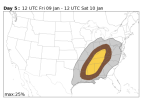
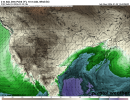
Things get interesting from here, especially with regard to the
model solution space. Big range of output within the
GFS and Euro
model suites, with each model core having a bias towards a slightly
different timing and overall solution. The primary player will a
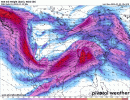
wave that digs into the west coast on Thursday over Nevada and into
the 4 corners region. How this phases with a system diving in from
the Arctic will have big implications for our weather Friday night
into Saturday, including severe potential.
The Euro/Euro
ensemble digs pretty sharply with the short wave into
the west coast, developing a potential
closed low that ejects out
into the Great Plains on Friday. This system phases nicely with an
upper level short wave being forced into the upper Great Plains by
sharp ridging that moves in behind these two waves over the west
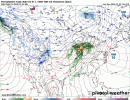
coast. Strong surface
cyclogenesis takes place across the center of
the county along an already established
baroclinic zone from a
previous surface low that deepens and pushes northeast as the
waves come into better alignment Saturday into Sunday.
This pushes
a front across the area Saturday afternoon that has access to day
time heating, plenty of moisture, and some decent upper level
support. CAPE values aren`t anything special (generally less than
500 J/kg), but may be offset a bit by dynamics and frontal
forcing. Shear is decent, with 50 kts of 0-6km and SRH values
above 100 m2/s2. Overall, not anything to sound alarms bells about
this far out, but definitely would be a day worth watching should
this solution play out.
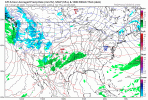
On the flip side is the
GFS/GEFS, which does not dig the initial
wave as sharply into the west coast on Thursday. This less amplified
system ejects a bit earlier compared to the Euro and does not phase
as nicely with the latter wave coming into the northern Great Plains
from the Arctic, at least initially. The timing of everything gets
pushed up a bit, and the end result is to push the
front through
during the middle of the night Friday into Saturday, rather than on
the day Saturday. This puts a bit more of a limit on
instability,
with the area being dependent upon
WAA for any additional surface
based heating. Still,
dynamics are okay and frontal forcing will be
present, so while this may represent a lower severe threat, hard to
call it "zero" severe threat this far out.
So, the tl;
dr for above is that while there is some uncertainty in
the forecast that will have overall impacts on the
thunderstorm
forecast, what we can say is that it will probably rain either
Friday night into Saturday or on Saturday (maybe both, given some
solutions that
lag a secondary low behind). This may end up being a
decent rain over the northern parts of the area - current forecast
amounts very pretty sharply from NW to SE which represents the
surface low darting quickly to the NE.
Mean QMD amounts within the
NBM
ensemble are ~1" across the north tapering to 0.25"-0.5" as you
move SW into central Georgia. 90th percentile shows upwards of 2"
decreasing to around an 1" to the SW - this
likely represents areas
that see more intense or more than one round of
convection. The 10th
percentile is worth mentioning, with less than 0.25" of rain
everywhere - this represents a weaker overall system that struggles
to tap into
moisture. This output seems less
likely given the model
solution space, but does show that solutions that struggle to
develop anything do exist.
Lusk