This post isn’t referring to Sunday, just thought I should list out the factors in determining a substantial tornado outbreak.
Upper levels
1. Jet translation speed of 40+knots.
2. A Neutral to Negative tilt trough which oftentimes leads to a jet streak orientation that’s close to perpendicular relative to the PBL winds, as this largely prevents upscale growth and promotes a discrete storm mode.
3. A large area of bulk shear of at least 50knots as to get anything to produce long trackers, storms need to be well ventilated to keep their mesocyclones healthy.
Mid levels
4. Storm relative winds of at least 35+knots, anything lower will likely cause a storm to be high precip, not often a big problem for a tornado, but definitely lower the chances of one being long tracked since rain cooled air usually cuts off the warm inflow towards the FFU of the supercell.
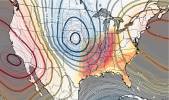
5. Deep height falls that lead to a surface low pressure of at least 990-mb. This needs to be the case, especially in winter/early spring months as anything weaker more often than not leads to insufficient moisture returns and directional shear.
6. Cyclonic vorticity streamer of at least 40^-5 S^-1 riding the back edge of the dryline or cold font; which produces strong forcing/QG ascent over the warm sector. This by itself would usually cause upscale growth, which is why jet orientation is a big deal.
Low levels
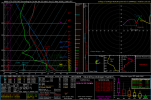
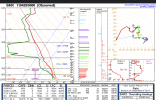
7. LLJ of at least 50+knots as this provides sufficient shear magnitudes (large curved hodographs) for storms to more easily tap into streamwise vorticity even when critical angles are far below 90degrees.
8. Dew points of at least 55-60 with temps in the low 70s or higher, this obviously produces high thermos (CAPE >1000mb) for storms to use.
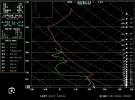
9. A stout inversion layer; without one, even if storm mode is discrete, you most certainly will end up with an over crowded warm sector and just overall a less unstable environment.
10. A large open warm sector, this much is obvious as the more room there is, the more time storms have to organize and continuously drop tornadoes.
11. This last ingredient is arguably the final piece of the puzzle that almost everyone doesn’t factor in, and yet determines if an event becomes a super outbreak or not; and that is the degree of PBL mixing.
If the PBL is too moist, like for example the March 15th outbreak last year, even if every other parameter is pristine, you will likely end up with an overcrowded, messy storm mode that prevents an outbreak from reaching its full potential. Instead, you need a well mixed PBL where it’s dry enough to prevent junk convection, but plenty moist enough to support powerful supercells. This is an incredibly difficult thing to balance, not even accounting for all of the 10 other conditions mentioned above that need to be met, which is why super outbreaks almost never happen.
Again, this is just a simplified guide of what to look for in identifying substantial tornado outbreaks, not noting any specific future event.