• Welcome to TalkWeather!
    We see you lurking around TalkWeather! Take the extra step and join us today to view attachments, see less ads and maybe even join the discussion.
    CLICK TO JOIN TALKWEATHER

Hurricane & Tornado Anniversaries

What’s also fascinating about the super outbreak are some of the mesoscale/other mechanisms at play. You can split the different outbreak regions into their own “tornado outbreak”.

Far Northern Indiana & Eastern Illinois storms with a mesolow.

Southeastern TN/Southwestern NC/North Georgia from a combination of a gravity wave, MCS decay into supercells, and rejuvenation of existing storms along a stalled front in that area.

OH/IN/KY storms from classic synoptic forcing and deep warm sector convection.

Alabama, Southern TN, Southeastern KY, and Northeastern TN storms from a combination of outflow boundaries, convergence, and training.
 
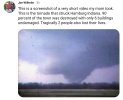
This is the first time I have seen the April 3, 1974, Hamburg, IN F4 (#36) and Temperance, KY F3 (#61) tornadoes themselves.

View attachment 52507

View attachment 52508
You should definetly post these in the significant tornado thread. I haven’t seen this photo of the Warren Co. (Alvaton) F3 either. Its parent Storm developed a little southwest of Nashville and tracked all the way up northeast of Richmond KY. It was responsible for 6 tornados total, with two being violent. The very underrated Mannsville F4 and then the Richmond KY F4.
 
Always an interesting fact about the Smithfield tornado. It has been confirmed by the NWS Birmingham that Ted Fujita did indeed consider ratibg the tornado an F6. The big three include:

Lubbock, TX 1970.
Xenia, OH 1974.
Smithfield/Birmingham, Al 1977.
 
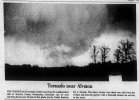
90th Anniversary of the 1936 Tupelo tornado today. Per the Storm Prediction Center, the Tupelo tornado is the 4th deadliest in US history.

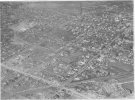
Part of a tornado family that began near Coffeeville in Yalobusha County, the storm moved ENE through central Lee County, passing through residential areas in the northern half of Tupelo. The tornado moved through mainly residential areas, leaving widespread destruction in its path.

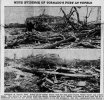
More than 200 homes were leveled, including many well-built homes on the west side of town. In addition, poorly constructed homes several miles west of Tupelo and on the northeast side of town were completely swept away.

Entire families were killed, including as many as 13 people in a single home. When the official death toll was set at 216, more than 100 injured survivors were still hospitalized.

The Mississippi State Geologist later estimated the true death toll may have been closer to 233, noting that only the names of white victims and injured residents were published in newspapers at the time.

Among the survivors was a 14-month-old baby named Elvis Aaron Presley, who survived the storm with his parents.

In the aftermath, approximately 150 boxcars were brought in to serve as temporary housing, and a local movie theater was transformed into a hospital, where even the popcorn machine was used to sterilize medical instruments.
 

Attachments

  • FB_IMG_1775444809649.jpg
    FB_IMG_1775444809649.jpg
    60.3 KB · Views: 0
  • FB_IMG_1775444837838.jpg
    FB_IMG_1775444837838.jpg
    64.1 KB · Views: 0
  • FB_IMG_1775444819678.jpg
    FB_IMG_1775444819678.jpg
    45.4 KB · Views: 0
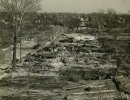
Today marks 90 years since the city of Gainesville, Georgia was hit by not one, not two but three tornadoes the morning after the Tupelo, Mississippi F5. An early unrated tornado hit Brenau University (than known as Brenau Collage), uprooting trees and causing minor damage to buildings on campus. Then, to the shock and dismay of the residents of the city, two massive, violent F4 tornadoes converged on downtown from the southwest and west. The two twisters merged in downtown, creating an almost half mile wide swath of devastation with debris piled as high as ten feet in some locations. The highest tornado-related death toll in a single building occurred as the Cooper Pants Factory was leveled and its remains were then swept by fire, killing at least 60 people.

The official death toll is 203 with at least 1,600 injured, however at least 40 people were still missing when this number was announced. Plus given that this was the 1930s in the deep south it's not likely there was a complete listing of black residents who were killed or injured, so the actual number of dead and injured is no doubt higher.


PTMyMCZjcm9wPTE


Mw


MCZzbWFydD10cnVl
 
90th Anniversary of the 1936 Tupelo tornado today. Per the Storm Prediction Center, the Tupelo tornado is the 4th deadliest in US history.

Part of a tornado family that began near Coffeeville in Yalobusha County, the storm moved ENE through central Lee County, passing through residential areas in the northern half of Tupelo. The tornado moved through mainly residential areas, leaving widespread destruction in its path.

More than 200 homes were leveled, including many well-built homes on the west side of town. In addition, poorly constructed homes several miles west of Tupelo and on the northeast side of town were completely swept away.

Entire families were killed, including as many as 13 people in a single home. When the official death toll was set at 216, more than 100 injured survivors were still hospitalized.

The Mississippi State Geologist later estimated the true death toll may have been closer to 233, noting that only the names of white victims and injured residents were published in newspapers at the time.

Among the survivors was a 14-month-old baby named Elvis Aaron Presley, who survived the storm with his parents.

In the aftermath, approximately 150 boxcars were brought in to serve as temporary housing, and a local movie theater was transformed into a hospital, where even the popcorn machine was used to sterilize medical instruments.
I heard many stories about this tornado growing up in Mississippi. I never thought it would be surpassed, so close to home.
 
Always an interesting fact about the Smithfield tornado. It has been confirmed by the NWS Birmingham that Ted Fujita did indeed consider ratibg the tornado an F6. The big three include:

Lubbock, TX 1970.
Xenia, OH 1974.
Smithfield/Birmingham, Al 1977.
I think it says something that all known instances of Ted Fujita toying with using an F6 rating for real occurred in the first few years of the Fujita Scale's operational use, with no known instances afterward. I'm willing to believe that he initially thought about using "F6" for really insane damage, but ultimately decided that (in the vast majority of cases at least) F5-level damage would be so complete that anything higher would essentially be redundant (at least without very thorough study).

Of course, the only one who would know for sure is Fujita himself, and seeing as how he's been dead for nearly three decades as of this writing, all we over here can do is speculate...
 
Today in 1856, a derecho struck in places like Ohio and Pennsylvania. Its peak intensity seems to have been from roughly Cleveland to just east of Philadelphia.

In Philadelphia, a tornado spawned by the derecho demolished an iron works boiler house while the derecho itself blew down several houses in the region, from Maryland to New Jersey. An apparent tornado in Alliance, Ohio unroofed barns for miles and, according to the Daily Pittsburgh Gazette, "not a barn within twenty miles escaped injury." In Smithfield, Ohio, nearly all of the buildings were reportedly demolished. 4 miles to the east, near Damascus, more buildings were leveled while a "clean swathe" of the forest was cut.

A "fine new" bridge across the Allegheny River at Kittanning, PA, recently opened, was lifted from its piers and tossed into the river. According to the same Pittsburgh paper, "At Kittanning, the storm partook of the nature of a whirlwind as trees and roofs appear to have been thrown in different directions." Several other bridges were destroyed, including one over the Juniata River at Huntingdon. A distillery was destroyed in Williamsport. $50,000 in damages were done when the York Furnace Bridge over the Susquehanna lost 4 spans.

Near Parkesburg, PA, a railroad engine was destroyed when it crashed into a car that had been blown off a siding onto the main track.

There were numerous other instances of significant damage from this derecho. If Tornado Archive is correct, there was a tornado near Gallitzin, PA, but I'm unable to verify that.

Other notable April 12 events include the very violent Rocksprings, TX tornado of 1927 and the Antlers, OK tornado of 1945. These are 2 incredible tornado events.

The Antlers tornado was a half-mile wide monster that spun through the small town situated near the foot of the rugged Kiamichi Mountains - well outside the usual flat country we associate with OK twisters. Allegedly the tornado was heard from as far as 25 miles away! Take that with a grain of salt, I suppose. 600 (!) structures were destroyed - notably one neighborhood of 15 houses had only 1 home standing. Houses were blown away completely, with no trace; cars were dropped thousands of feet from their original spot; one tractor trailer was reportedly mangled and tossed a mile from its original spot. 69 people were killed, 1,500+ were homeless, and 10%+ of the town's residents were killed or hospitalized. Other tornadoes, some intense, were noted from eastern Oklahoma through the Ozark Mountains, with a few small ones in western Illinois.

The Rocksprings tornado was an estimated mile wide tornado that was either rain-wrapped or a ground-scraping meso because it lacked any visible funnel. Grazulis estimated that the tornado destroyed 235 of the 247 buildings in town. With the exception of the 1975 Pearsall tornado, this part of Texas has seldom seen a violent tornado before or since.
 
Back
Top