On January 6-7, 1839, arguably the most potent storm to bit the city of Dublin and other areas of Ireland. Nicknamed "the Night of the Big Wind", translated in Irish to Oíche na Gaoithe Móire.
The storm began to really ramp up towards 11pm and only began calming down around 3:30am.
"winds increased in fury every hour, until eleven and twelve o’clock when it raged with all the horrors of a perfect hurricane"
As the storm struck at its most intense, the town of Clonmel, Co Tipperary had these reports
"Heavy rain fell in torrents and was blown so impetuously against the windows that several of them smashed"
In Clifden, County Galway, 17 fishermen died due to the intense storm surge and intense hurricane force winds, that took place. Their bodies were "cruelly thrown on shore"
To best summarise the devastation left by this event, the Tuam Herald sums all areas affected up pretty well.
Armagh: Many houses stripped of their roofs
Athlone: Storm continued with unabated fury from 11pm ‘til 3.30am. One of the hardest hit areas with much loss of life.
Ballinasloe: Much devastation, with great woods felled.
Ballyshannon: Great destruction of property and livelihoods.
Belfast: A violent westerly bringing death and destruction.
Birr: One boy and three females killed.
Carlow: Serious injury reported but escaped the worst of the winds.
Carrickfergus: Tree in graveyard uprooted forcing many of the dead to the surface.
Carrick-on-Shannon: The produce of the harvest lies scattered over the whole countryside.
Castlebar: Widespread damage with few houses left unscathed.
Coonagh: 3 killed in storm
Derry: Visited by a storm of extraordinary violence
Co. Down. Much damage but escapes relatively well.
Drogheda: Never within the memory of man has this town and neighbourhood been visited with such an awful storm.
Dublin: The metropolis was, on Sunday night, visited by a hurricane such as the oldest inhabitants cannot remember. Two known deaths as a result.
Ennis: Scene ofterrible calamity.
Galway: At least 7 dead. Men, women and children screaming, crying with raw terror.
Gort: Total devastation. One of the worst hit areas
Kilkenny: Many houses burned down during the storm.
Killarney: Hurricane raged with terrible fury
Kinsale: Destruction is not so terrible, as far as we can learn.
Co Laois: The destruction of trees is prodigious.
Limerick: Badly hit. Lightning and wind made for an awesome sight.
Longford: Barely a house left standing.
Loughrea: Devastated.
Mullingar: Suffered severely-to the utter ruin of its inhabitants.
Roscommon: These immense plains have been swept through by a fury.
Sligo: To give a full description of the devastation would be morally impossible.
Tralee: Hurricane reaps disaster.
Waterford: Visited by the most terrific storm ever remembered.
Synoptically, what caused such a anomalously intense and devastating storm?
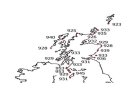
The low itself was recalled to be around 918 mb, but was later resolved to 930 mb after reanalysis in the 2000s. The setup was just north of Ireland and West of Scotland in a perfect position for the low to maintain intensity but the majority of the country to be wildly affected in catastrophic ways.
These are the sea level pressure readings from the event.
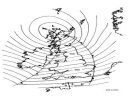
And also, the synoptic chart of it. Very close isobars indicating a intense wind event ongoing.
The event most likely breached 100-110+ mph winds across the majority of the country, assuming some sort of intense sting jet was also present with this.
A first hand account by Thomas Russell would show just how truly inexperienced these residents were to this type of condition:
The most terrible thing I have ever heard was the roaring of the wind on that awful night. I can never forget it, nor can anyone who heard it forget it. It made the stoutest and bravest that heard it quail. No one who did not hear the horrible sound – something between a howl and a roar – that the wind made on that night can form even a remote idea of its unutterable awfulness. It was hardly to be wondered at that almost everyone thought that the end of the world had come. Those who had probably never felt fear in all their previous lives were like babies, and wept like them”.
Over 25% of homes in Dublin were destroyed as a result of the event.
I've always wondered when the next true Oíche na Gaoithe Móire will happen. Shall it happen and hopefully not, i would try to give my best documentation of the event as it's seemingly the most volatile windstorm to ever hit the country. The synoptic and large windfield was perfect for maintaining a constant swath of 90+ mph winds. It is only a matter of time before something like this takes place again and hopefully, we will be better prepared.