• Welcome to TalkWeather!
    We see you lurking around TalkWeather! Take the extra step and join us today to view attachments, see less ads and maybe even join the discussion.
    CLICK TO JOIN TALKWEATHER

Severe WX Severe Weather 4/11 - 4/15

Theres a reason at this range we should just be saying this is a synoptically evident severe weather setup. Its probably going to trend up and down several times between now and when the big trough ejects. Trying to nail anything down right now is like putting out a snowfall map 5 days out.
 
I'm just here for the entertainment now. My work here is done. Identifying this upcoming threat and look out for uptick in severe storms in April back in mid March.
March 17th FB/Twitter post: "A greater severe storm threat may develop beyond April 3rd"
 
Anyone have any thoughts on the 12z Euro? Tuesdays threat seems to be rapidly diminishing.
It's Thursday. This is exactly what I was talking about by living and dying by every deterministic run that comes out. If this comes off harsh, i don't want it to, but come on man. They're just ideas, there will be changes. We may downtrend or uptrend
 
Dude, saying it's rapidly diminishing 5+ days out, off one model run, is as bad as the ones hyping it, lol. It will change many times between now and then, have patience.

It's been trending more bearish for a couple runs across multiple models. I get what you're saying, but this is also a discussion thread for the event, and I'm just trying discuss lol.
 
Being conservative on setups are a true rarity nowadays. It seems like the major influx of people into weather since prob 2024 or last year has rapidly changed the angle of hype into the main thing. Subconsciously, people want to hear the higher end solutions and ignore the cons and focus on the pros of every setup because to them, that looks major. I've seen someone be conservative on a few setups this year on a YouTube community post, and he got slandered for being too conservative on the setup despite him saying he didn't want to jump abroad the train of hype.

I really do wonder how this affects public messaging for the next while because it's becoming increasingly rarer to find genuine, life saving and helpful information about these setups that isn't 4 photos of a ICON deterministic run with the LLJ, 500 mb jet, moisture and the sounding they took from that area.

This is what @Grand Poo Bah spoke about when Reed threw that post around, how it affects family plans and etc but i also think his messaging can partially influence others to think it's acceptable to throw that language around with setups.

Nobody's perfect when it comes to forecasting, but if this sequence doesn't come to fruition like most have painted it on Twitter, public backlash will be rife
 
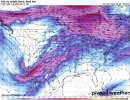
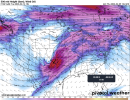
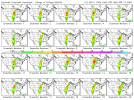
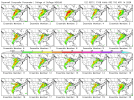
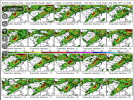
Based on the 12z GFS I ran a quick jet translation speed calc between 00z and 18z on the 14th.
Screenshot 2026-04-09 at 2.14.43 PM.pngScreenshot 2026-04-09 at 2.30.57 PM.png
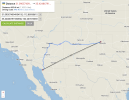
The X's marked are where I ascertained the core of the jet streak to be located. The distance between them is about 685 miles (based on this website):
Screenshot 2026-04-09 at 7.21.21 PM.png
Calculation: (685 mi) / (18 hr) ≈ 38 mph.
Converting to knot -> (38 mph)(0.868... kt/mph) ≈ 33 kt.

This is not in excess of the threshold defined by Broyles. I do want to mention, though: The jet translation speed during the first 6 hours (so 00z to 06z) is much slower than the next 12 hours (06z to 18z). This means that the jet is likely translating above that 40 kt threshold during the timeframe of the event. However, I did not conduct any further calculations for that, as Broyles et al. does not utilize this methodology for intervals shorter than 18 hours. It's just something I found very intriguing.

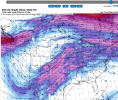
Also, this value increases to something I have not yet calculated in the 18z GFS run, the core of the jet streak is further west at 00z on the 14th and further northeast at 18z on the 14th for the most recent run. I would eyeball a guess of about ~36 kt or perhaps even greater if I re-ran the same analysis for the most recent run. Something to watch.
 
Last edited:
Based on the 12z GFS I ran a quick jet translation speed calc between 00z and 18z on the 14th.
View attachment 52661View attachment 52662
The X's marked are where I ascertained the core of the jet streak to be located. The distance between them is about 685 miles (based on this website):
View attachment 52663
Calculation: (685 mi) / (18 hr) ≈ 38 mph.
Converting to knot -> (38 mph)(0.868... kt/mph) ≈ 33 kt.

This is not in excess of the threshold defined by Broyles. I do want to mention, though: The jet translation speed after the first 6 hours (so 00z to 06z) is much slower than the next 12 hours (06z to 18z). This means that the jet is likely translating above that 40 kt threshold during the timeframe of the event. However, I did not conduct any further calculations for that, as Broyles et al. does not utilize this methodology for intervals shorter than 18 hours. It's just something I found very intriguing.

Also, this value increases to something I have not yet calculated in the 18z GFS run, the core of the jet streak is further west at 00z on the 14th and further northeast at 18z on the 14th for the most recent run. I would eyeball a guess of about ~36 kt or perhaps even greater if I re-ran the same analysis for the most recent run. Something to watch.
Key to note that jet translation speed isn't all it, and that things like STP and etc are required to make that actually a useful statistic, if STP isn't over 4, then a (major) tornado outbreak can't be considered.

Significant tornado events HAVE occurred with 30+ kts jets and i actually asked Broyles about this a bit ago and he had plenty of cases that featured this.

A notable example was 5/24/16 in Dodge City. We continue to see how this trends but confidence would certainly be lower in issuing a D5 30% imo for this compared to this morning when things looked better in terms of agreement to support a well timed trough ejection.
 
Key to note that jet translation speed isn't all it, and that things like STP and etc are required to make that actually a useful statistic, if STP isn't over 4, then a (major) tornado outbreak can't be considered.

Significant tornado events HAVE occurred with 30+ kts jets and i actually asked Broyles about this a bit ago and he had plenty of cases that featured this.

A notable example was 5/24/16 in Dodge City. We continue to see how this trends but confidence would certainly be lower in issuing a D5 30% imo for this compared to this morning when things looked better in terms of agreement to support a well timed trough ejection.
Absolutely true. The first example that comes to mind for me is 5/31/85, which actually had a jet translation speed of at or just below 33 knots, similar to this. Ever since I did the calculation for the big trough that came through earlier this year, I've found it fun to do this, lol.
 
Absolutely true. The first example that comes to mind for me is 5/31/85, which actually had a jet translation speed of at or just below 33 knots, similar to this. Ever since I did the calculation for the big trough that came through earlier this year, I've found it fun to do this, lol.
I agree, it's fun to put into work this research and experiment with it all of these setups that show up. Wonder if you could collect like a little spreadsheet for these systems and notice potential patterns in how they performed.

I feel like there's something else regarding jet translation speed that we don't truly understand, and maybe it'll make more sense why outbreaks like 5/31/85 took place despite them breaking the classic rule of 40+ kt.

Also, latest GFS run says that while spatial extent of our (potentially) potent environment on Tuesday may be limited, it's still a interesting window for all hazards to take place especially with that jet overlap that makes sense.

Think the 18z would support a stronger 36+ kt range on this one too, from a quick estimate
 
I’m not opining on Tuesday yet since I actually haven’t done a deep look into the models.

With that said, something I’ve learned over the years is at this range it’s best to look at the ensembles first then the deterministic to see if a majority of its own members disagree with the run in question. Ive definitely been someone who called for outbreak or bu$t based on each deterministic model run leading up to an event lol but now really ride with the ensembles until we are close.

The other thing, and it’s been mentioned ad nauseam, is that models flip flop. A lot. They can also be completely out to pasture until mere hours before the event. They’re really good, but not perfect. Prime example was 3/14 and 3/15 last year. For days, 3/15 was the headliner day, and you even had a 5/20/2019-lite supercell printing HRRR run the night before. On the other hand, 3/14 looked like a moisture starved QLCS event. Look how both of those days turned out.

Your big events sometimes rapidly uptrend the day of. The trough on 3/31/23 came in more zonal the morning of. I would say 3/14 uptrended last year. That whole week of the 3/31 event, it was supposed to be the appetizer for 4/4, which was looking to be a very high end event. Look how that turned out.

Also, don’t underestimate on shore sampling of the system. Once the system actually gets on shore and is sampled, the models get a better handle usually.
 
I’m not opining on Tuesday yet since I actually haven’t done a deep look into the models.

With that said, something I’ve learned over the years is at this range it’s best to look at the ensembles first then the deterministic to see if a majority of its own members disagree with the run in question. Ive definitely been someone who called for outbreak or bu$t based on each deterministic model run leading up to an event lol but now really ride with the ensembles until we are close.

The other thing, and it’s been mentioned ad nauseam, is that models flip flop. A lot. They can also be completely out to pasture until mere hours before the event. They’re really good, but not perfect. Prime example was 3/14 and 3/15 last year. For days, 3/15 was the headliner day, and you even had a 5/20/2019-lite supercell printing HRRR run the night before. On the other hand, 3/14 looked like a moisture starved QLCS event. Look how both of those days turned out.

Your big events sometimes rapidly uptrend the day of. The trough on 3/31/23 came in more zonal the morning of. I would say 3/14 uptrended last year. That whole week of the 3/31 event, it was supposed to be the appetizer for 4/4, which was looking to be a very high end event. Look how that turned out.

Also, don’t underestimate on shore sampling of the system. Once the system actually gets on shore and is sampled, the models get a better handle usually.
Given the fact that the HRRR experienced model errors on that day which caused the extreme output since it was depicting several MCVs with supercells, i have to wonder if 3/15 experienced this too
 
It's Thursday. This is exactly what I was talking about by living and dying by every deterministic run that comes out. If this comes off harsh, i don't want it to, but come on man. They're just ideas, there will be changes. We may downtrend or uptrend
I hear you guys. Apologies if I came off hyperbolic. Keep in mind it's a little harder to not to dive deep into every run when you're dead center of the peak tornado conditions. This was/is looking the highest ceiling event we've seen around here since May 2024 or longer. I'm getting caught up in the whirlwind a bit, and relaying all the changes I'm seeing.

Being conservative on setups are a true rarity nowadays. It seems like the major influx of people into weather since prob 2024 or last year has rapidly changed the angle of hype into the main thing. Subconsciously, people want to hear the higher end solutions and ignore the cons and focus on the pros of every setup because to them, that looks major. I've seen someone be conservative on a few setups this year on a YouTube community post, and he got slandered for being too conservative on the setup despite him saying he didn't want to jump abroad the train of hype.

I really do wonder how this affects public messaging for the next while because it's becoming increasingly rarer to find genuine, life saving and helpful information about these setups that isn't 4 photos of a ICON deterministic run with the LLJ, 500 mb jet, moisture and the sounding they took from that area.

This is what @Grand Poo Bah spoke about when Reed threw that post around, how it affects family plans and etc but i also think his messaging can partially influence others to think it's acceptable to throw that language around with setups.

Nobody's perfect when it comes to forecasting, but if this sequence doesn't come to fruition like most have painted it on Twitter, public backlash will be rife

Exactly. It seems like it's ALL hype, and when a system trends more bearish it's mostly ignored. It almost creates a hype echo chamber that builds and builds until the day of the event, when people are blindsided if it underperforms (even though there was plenty of evidence it might along the way). I think it's worth mentioning when the models flip because bearish runs are just as viable as bullish ones. There have been way more runs with this system across all the models where Tuesday is a moderate or enhanced day, rather than a high risk one, but the high risk runs are still what most of the wx community is clinging to.

It seems to all be coming to a head this year especially. All the influencers are pining for the type of engagement they were getting this time last year (because of the extremely active March/April), and are having to increasingly "embellish" the truth to get it. When they're right it's no harm no foul, but when they're wrong (and they've been wrong a lot this year) it degrades public trust and people become a little less alert each time.
 
Given the fact that the HRRR experienced model errors on that day which caused the extreme output since it was depicting several MCVs with supercells, i have to wonder if 3/15 experienced this too
The hardest thing to do in modeling is correctly sampling the atmosphere; most model error comes down to discrepancies between initiation and reality. Counterexamples to 3/15/25 are 6/20/25 and 3/10/26, on both days, models initialized too cold, which threw off downstream outputs.
 
Back
Top