• Welcome to TalkWeather!
    We see you lurking around TalkWeather! Take the extra step and join us today to view attachments, see less ads and maybe even join the discussion.
    CLICK TO JOIN TALKWEATHER

Severe WX Severe Weather Thread - 6/15/26 - 6/18/26

The absolute bottom of the barrel floor for this event is 2 to 4 sig tors, no VI tors.
The ceiling is straight up a Palm Sunday redux.
Palm Sunday with less tornadoes. The question is coverage rather than intensity, and many, if not most, tornadoes that last more than a few minutes will be significant considering the forecasted environment.
Palm Sunday 2: Electric Boogaloo
 
I'm glad to see that this forum is realising the potential for tomorrow. I never like saying it but we are talking the potential for EF4-EF5 type tornadoes tomorrow. We're not playing around. The ceiling is serious tomorrow. If you have family members in this area, warn them. Linear portion of this event will be a potentially prolific QLCS. I've just done a post on the r/Indiana subreddit to warn those in this risk and show the environment at play.
 
Not as the ceiling, but in general, maybe something like the 4/12/2020 outbreak by intensity, not numbers. That event had 13 EF3s and 1 EF4. I don't think we see the sheer number of tornadoes that outbreak produced by any means, but the percentage of significant tornadoes was pretty decent and I think whatever manages to drop tomorrow could really get going. I could see something in the 11/17/2013 range as well.
 
Not as the ceiling, but in general, maybe something like the 4/12/2020 outbreak by intensity, not numbers. That event had 13 EF3s and 1 EF4. I don't think we see the sheer number of tornadoes that outbreak produced by any means, but the percentage of significant tornadoes was pretty decent and I think whatever manages to drop tomorrow could really get going. I could see something in the 11/17/2013 range as well.
I disagree actually, that number of tornadoes is well within reach. If anything, this system has a higher middle ground than the 2020 Easter outbreak.
The Easter outbreak most certainly had a much lower ceiling as well.
 
I disagree actually, that number of tornadoes is well within reach. If anything, this system has a higher middle ground than the 2020 Easter outbreak.
The Easter outbreak most certainly had a much lower ceiling as well.
4/12-13/2020 had 141 tornadoes. I guess we could potentially see that. I do absolutely agree that the middle range here is higher than 2020. I don't think it was apparent really until day of that the Easter outbreak was going to hit its ceiling.
 
4/12-13/2020 had 141 tornadoes. I guess we could potentially see that. I do absolutely agree that the middle range here is higher than 2020. I don't think it was apparent really until day of that the Easter outbreak was going to hit its ceiling.
The QLCS portion of the 4/12/2020 outbreak did most of the heavy lifting though in that event. While we got two incredibly long-lived, discrete supercells in southern MS that afternoon that produced violen, long-track tornadoes, the vast majority of the warm sector did not realize its full potential. Bad lapse rates, combined with Junkvection and a messy convective mode further north, largely kept OWS quiet. If a few subtle things break differently that afternoon, we’re talking about anything from a 4/28/2014 event to something approaching April 27, 2011.

However, the incredible dynamics at-play allowed the embedded supercells to produce several strong/intense tornadoes throughout the overnight and early morning hour on the 13th before breaking them into a more discrete mode in SC that produced several intense tornadoes. The SC portion of the event was similar in some respects to the 4/16/2011 event in the Carolinas.

I do think with the kinematics we’re talking about tomorrow that even a quicker transition into a QLCS could still result in several strong/intense tornadoes into the evening and overnight hours.

I would be surprised if we got a tornado count that high tomorrow, but the ceiling is there.
 
4/12-13/2020 had 141 tornadoes. I guess we could potentially see that. I do absolutely agree that the middle range here is higher than 2020. I don't think it was apparent really until day of that the Easter outbreak was going to hit its ceiling.
Oh, you’re talking about total tornado count and not specifically sig tor count.
In that case I agree, the spatial extent for this event is definitely going to limit the overall tornado numbers.
Considering boundary riders, dry line convection, and maybe the possibility of one or two OWS storms, I would put the maximum number of tornadoes we could see at perhaps 70.
 
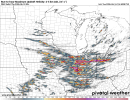
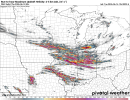
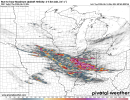
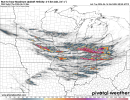
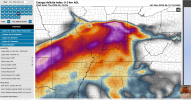
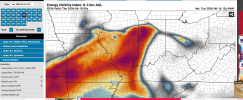
Hello, I have a quick question. I have noticed a trend on the 12z model runs today. A few model runs, NAM, RRFS and GFS it seems. Yesterday over Indiana as you can see on the attached image EHI values were 6 plus over a large area, and today half of the state is zero. Is this from mixing during the day? Less moisture making its way north? Or some sort of lower level inversion? Curious if this will have any impact? Just something I noticed. Thanks!
 

Attachments

  • NAM 12z June 15.png
    NAM 12z June 15.png
    1.1 MB · Views: 12
  • NAM 12z June 16.png
    NAM 12z June 16.png
    774.6 KB · Views: 14
Oh, you’re talking about total tornado count and not specifically sig tor count.
In that case I agree, the spatial extent for this event is definitely going to limit the overall tornado numbers.
Considering boundary riders, dry line convection, and maybe the possibility of one or two OWS storms, I would put the maximum number of tornadoes we could see at perhaps 70.
I mean Palm Sunday is a good analog bc it didn't have a ton of nadoes but like all of em were intense-vio long lived tors so it evens out
 
Oh, you’re talking about total tornado count and not specifically sig tor count.
In that case I agree, the spatial extent for this event is definitely going to limit the overall tornado numbers.
Considering boundary riders, dry line convection, and maybe the possibility of one or two OWS storms, I would put the maximum number of tornadoes we could see at perhaps 70.
I was thinking we wouldn't hit total tornado count but yep, definitely agree could hit sig tor count for sure. 70 feels right to me as a total given that the SPC mentioned something about even a QLCS evolution becoming a fairly prolific tornado producer.
 
I think the details of these events may differ enough that it’s not apples-to-apples, but the closest analog I can think of for a June event like this in the region would be June 2, 1990. That was day that produced several long-lived discrete tornadic supercells which resulted in seven violent tornadoes. Indiana was particularly hit hard that day with 37 tornadoes occurring, the most the state had experienced since the 1974 Super Outbreak.

This is probably the most slept on or under appreciated outbreak of the past 50 years given that the significant and violent tornado count exceeds any single outbreak day except for the big three (1965, 1974, 2011).

 
The only uncertainty I could see the SPC holding back a high is nailing down just how far north the threat for strong tornadoes are, because you have the HRRR in 12Z having the threat be as far north as Northern IL/IN, around Marshall County (just south of South Bend in St. Joseph County), while other CAMs show from Joliet IL to west of Fort Wayne, then down towards Indianapolis. Just all depends on how quickly and far north the warm front goes.

I may just be spewing nonsense, but I know the SPC when they issue high risks, they want to be precise and very confident in the location because of how significant issuing a high risk can be in regards to messaging.
 
Hello, I have a quick question. I have noticed a trend on the 12z model runs today. A few model runs, NAM, RRFS and GFS it seems. Yesterday over Indiana as you can see on the attached image EHI values were 6 plus over a large area, and today half of the state is zero. Is this from mixing during the day? Less moisture making its way north? Or some sort of lower level inversion? Curious if this will have any impact? Just something I noticed. Thanks!
EHI takes into account both vertical instability and shear. This is just model variability with CAPE, which is why you will see these values go up and down. Overall it matters none.
But at face value, you can have cape as low as 200 and still have a long track VI tor. As long as shear is high enough.
 
Last edited:
Back
Top