One of my weather friends posted this on Facebook and I was not familiar with it. So, I thought it may be new to some of you as well. Link to the article is
here. For those of you who are familiar with it, want to catch the rest of us up?
For the first time, forecasters with the National Weather Service detected and issued a warning for a tornado based fully on a new generation of radar called Phased Array right here in Oklahoma.

www.kjrh.com
Hey Michelle, I'm no expert on this by any means, but I do have a personal connection to it. My father had a hand in the missile side of this technology, working on the Patriot missile system and later the SBX, that big floating radar out in the Pacific that looks like a golf ball on a barge.
Most of us have grown up watching those big spinning radar dishes on TV. The NEXRAD network has been in place since the early 90s and it works great, but that full 360-degree sweep has to be repeated at multiple elevation angles to build a complete picture of a storm from the ground up. By the time it works through all those levels it takes about 4 to 5 minutes to complete a full volume scan. In a tornado situation, that's a long time to be flying blind between updates.
Phased Array Radar throws the spinning dish out the window entirely. It's a flat panel covered in thousands of tiny antenna elements that steer the beam electronically with no moving parts and no waiting on a rotation. The big difference is that it can sample multiple elevation levels simultaneously rather than having to sweep each one individually. The result is a complete volume scan about four times faster than what we have now.
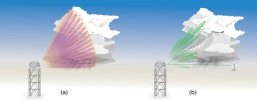
(PAR is picture a and shows how the PAR can scan all levels much faster than the traditional NEXRAD in picture b that has to scan an elevation, then move to the next elevation and so on)
On April 28th, NWS forecasters in Norman had access to a research unit called the Advanced Technology Demonstrator and were watching a supercell develop near Caney, Oklahoma. They said they could see the rotation ramping up much sooner than they would have with traditional radar, got the warning out, and it ended up being an EF-2. It was the first time in history a tornado warning was issued based entirely on phased array data in a live operational setting.
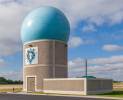
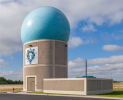
<-- Outside View
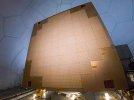
<--- Inside View
What I found interesting is that this technology didn't start in weather at all. It came out of missile defense, and Redstone Arsenal in Huntsville, Alabama was right in the middle of that story. The Patriot missile system's name is literally an acronym for "Phased Array Tracking Radar to Intercept on Target." The Army needed something that could track a fast-moving ballistic missile without waiting on a dish to spin around, so they built a radar that could redirect its beam instantly.
Turns out that same capability is exactly what you need to watch a tornado spin up in real time. Same physics, very different mission.
Another example is the Starlink dish sitting on someone's roof is a phased array. That flat dish electronically tracks satellites moving at over 17,000 miles per hour, hands off between satellites every few minutes