• Welcome to TalkWeather!
    We see you lurking around TalkWeather! Take the extra step and join us today to view attachments, see less ads and maybe even join the discussion.
    CLICK TO JOIN TALKWEATHER

SPC Outlook Changes March 2 2026

I’m a weather weenie and even I’ve had to actually sit down and study this to discern this change. I agree with a lot of the other posts here, I see the value in this, but it’s not very intuitive.

I’ll be extremely interested in hearing what Spann says about this since he really hammers home the public messaging aspect of all this. He’s been on record with his viewers being confused by “moderate vs enhanced” before.
 
I’ll be extremely interested in hearing what Spann says about this since he really hammers home the public messaging aspect of all this. He’s been on record with his viewers being confused by “moderate vs enhanced” before.
I've never understood the risk level names; I think "moderate" being the second-highest is a weird name choice but I digress. I always say it should go:

None > Minimal > Slight > Moderate > High > Extreme/Catastrophic

The tornado probabilities maxing out at 60% is also confusing.
 
The general public does look at SPC outlooks - if they didn't, news outlets like WHNT wouldn't be reporting on the change. It's not the operational aspect (obviously it'll be helpful), just how it's presented to the public. Regardless of who reads it, the outlooks should still be readable to a wide audience (the synopses aren't readable to 90% of people anyways, so your best bet on conveying a threat is via the graphic). The government is for the people, after all.
I could've worded it better but the majority don't, and that's why I see this change more up to news outlets in order to message events properly. In my opinion, it certainly helps differ areas that have EF2+ potential versus the potential for violent tornadoes. I do personally think the idea i suggested of just putting on top the intensity instead of using the CIG1-3 would work. It's too technical for the public to explain what CIG1 is and just simply explain that a "EF2+ tornado threat exists here" and with CIG3 "A violent tornado threat will be likely in these areas" etc. It might take some time for the public to get used to the new hatching systems and that's fine, not expecting the public to immediately adjust.
 
I’m a weather weenie and even I’ve had to actually sit down and study this to discern this change. I agree with a lot of the other posts here, I see the value in this, but it’s not very intuitive.

I’ll be extremely interested in hearing what Spann says about this since he really hammers home the public messaging aspect of all this. He’s been on record with his viewers being confused by “moderate vs enhanced” before.
I think moderate does a poor job of messaging a threat. 12/10/21 was a Moderate, 5/21/24 was a Moderate. It's just not a ideal way of messaging a dangerous threat to me because many outbreaks have been in a moderate and some have been remembered.
 
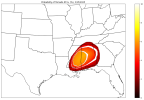
SPC has uploaded example GRIB files of data they will start publishing once the changes take effect. In the new WMO headers they list "Continuous Unconditional Probabilities ..." of hail/wind/tornadoes. I pulled the files and threw together a quick visualization for 3/15/25
for the probability of an EF3+ tornado.

spctest.png

I'm not sure if the odd banding is in the data itself or if it's in my parsing of it. Either way, this is an interesting set of new products. I don't know if they are going to be publishing these graphics, but if not, I'd be willing to pull the data and publish them (contingent on finding a good source for the GRIB files)
 
With the new addition of 45% CIG3 for wind being a compatible high risk designation, that means that it was potentially possible for 6/20/25 to be a wind-driven high risk, although I’m not sure on whether or not a CIG3 or CIG2 for that day would have been issued in the forecast. I do believe that a 45% CIG3 for wind was absolutely on the table, considering the confidence in a very powerful straight line wind event in the hours prior to it occurring.

Would be funny if a wind driven high was eligible for that day - it would mean that the first day to have an EF5 in 12 years came out of a setup that didn’t feature tornadoes as its main threat.
 
I'm assuming the day 4-8 outlooks are unaffected by it? The official announcement says that the "SPC will begin issuing conditional intensity forecasts of significant severe weather for Days 1, 2, and 3" but doesn't mention anything past that.
 
The Day 4-8 Outlooks will stay the same. It'll take some time to adjust and get use to. I'm sure there will be improvements to it over the coming years which is why I'm not worried about it. I'm still adjusting to the "Cold Weather Advisory" which they should have just left as a Wind Chill Advisory.
 
The Day 4-8 Outlooks will stay the same. It'll take some time to adjust and get use to. I'm sure there will be improvements to it over the coming years which is why I'm not worried about it. I'm still adjusting to the "Cold Weather Advisory" which they should have just left as a Wind Chill Advisory.
Yeah. I know a lot of people are taking issue with the conditional hatching being confusing, but where this matters is helping to communicate threat geography better. I can probably count the number of times my local mets actually mentioned hatched SIG areas in a meaningful way in the past 20 years on my two hands. Additional contextualization of potential risk will give them more robust official guidance to give further emphasis to areas with the highest threat in a way that isn't dependent on category colors or words.

The category names is an ongoing, years-old issue - I personally liked the way BMX used to do it: Limited, Elevated, Significant, Extreme - but public-facing outlets are starting to use the numerical category names a lot more lately, so that works, too.
 
Yeah. I know a lot of people are taking issue with the conditional hatching being confusing, but where this matters is helping to communicate threat geography better. I can probably count the number of times my local mets actually mentioned hatched SIG areas in a meaningful way in the past 20 years on my two hands. Additional contextualization of potential risk will give them more robust official guidance to give further emphasis to areas with the highest threat in a way that isn't dependent on category colors or words.

The category names is an ongoing, years-old issue - I personally liked the way BMX used to do it: Limited, Elevated, Significant, Extreme - but public-facing outlets are starting to use the numerical category names a lot more lately, so that works, too.
I prefer the numerical category as well.
 
Nervous Rap Game GIF by TrueReal

We're one week out from this launching; I almost can't wait to see what it will look like. Imagine the amount of weenie'ing that will happen on a CIG3, 60# high-risk tornado day...

It seems the first significant application of this might be sometime in mid-March, maybe from the 10th-16th.
 
In case anyone missed it (I believe someone posted it in the general yearly severe weather thread), here's Trey's breakdown/discussion of these changes featuring not one but two SPC meteorologists, including everyone's favorite.

 
After watching that video and hearing their reasoning behind the changes, I'm all for it. I really like the idea of (mostly) divorcing probability/coverage from intensity. There are situations where there's high confidence in coverage but a lower ceiling (QLCS wind/spinup tornadoes in SE winter/small tornadoes in the feeder bands of a hurricane) and lower confidence in coverage/occurrence (big EML days) but a high ceiling. Being able to better communicate those differences is going to be HUGE.
 
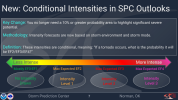
I’m surprised this was never pointed out, but the SPC graphic for the CIG groupings put the max expected intensity at CIG3 for EF4 - this implies EF5 tornadoes are non-existent.
IMG_2081.png
Obviously that’s not what they intend, but it’s funny regardless.
 
I'm usually on the side of "don't overcomplicate communication" but I'm a fan of the addition of CIG1-3.

I think we generally overstate just how many people get their weather from spc.noaa.gov. It's a lot less than we think it is. Those going to the website are generally pretty informed about the weather.

If they have been as successful internally as they claim they have been in testing, CIG1-3 will be a great addition and will save lives.

I'll be interested to see how TV Mets and WFOs try to explain these terms to the layman. I imagine the hatches won't look pretty in WSI/Baron broadcasting software.
 
I'm usually on the side of "don't overcomplicate communication" but I'm a fan of the addition of CIG1-3.

I think we generally overstate just how many people get their weather from spc.noaa.gov. It's a lot less than we think it is. Those going to the website are generally pretty informed about the weather.

If they have been as successful internally as they claim they have been in testing, CIG1-3 will be a great addition and will save lives.

I'll be interested to see how TV Mets and WFOs try to explain these terms to the layman. I imagine the hatches won't look pretty in WSI/Baron broadcasting software.

It's pretty rare for broadcast mets to show the probabilistic hazard outlooks, even on high-end days. At my station I've only ever seen them show the categorical outlooks (usually labeled as "Level 1-5"). We use WSI/The Weather Company Max Studio.
 
I've talked to one of my friends about this very thing if TV mets showed it on air. I would just keep it simple with you are in a hatched risk for such and such without going into depth. I wouldn't even add or say the word conditional on air. Because imagine you are the viewer and hear the words "we are in a conditional hatched tornado risk". I mean I'm still gonna treat it as a significant hatch area even though it won't actually be called that.
 
Back
Top