

Navigation
Install the app
How to install the app on iOS
Follow along with the video below to see how to install our site as a web app on your home screen.
Note: This feature may not be available in some browsers.
More options
-
Welcome to TalkWeather! We see you lurking around TalkWeather! Take the extra step and join us today to view attachments, see less ads and maybe even join the discussion. CLICK TO JOIN TALKWEATHER
You are using an out of date browser. It may not display this or other websites correctly.
You should upgrade or use an alternative browser.
You should upgrade or use an alternative browser.
Severe Weather Threat January 8-10, 2026
- Thread starter CheeselandSkies
- Start date

Cyclonic Paracosm
Member
I've been seeing several things abt that region today and I can see why, its way better than fridays crap
- Thread starter
- #143

CheeselandSkies
Member
Eh. Seems like the system lags too far back to the west for a substantial threat in those states on Thursday, unless he's talking about overnight (looks like he is, those frames are valid for 02Z/8 PM CST). I'm not enough of a "never stop chasing" type to drive 6+ hours each direction for a purely nocturnal threat. I only chased the KS supercell on 5/18/25 because (a) I was already in the area and (b) it was clearly a monster that was going to persist for a while.
Friday could be decent in Illinois per the 0Z Wednesday 3K NAM, if only the system would slow down a bit and the cold front wasn't already halfway across the state by 12Z (6 AM CST).
Friday could be decent in Illinois per the 0Z Wednesday 3K NAM, if only the system would slow down a bit and the cold front wasn't already halfway across the state by 12Z (6 AM CST).

I've been seeing several things abt that region today and I can see why, its way better than fridays crap
Definitely don't sleep on Friday. Especially in Louisiana and Mississippi. They've got 1500 cape, a strong LLJ, are right on the leading edge of the Jet streak, and plenty of sheer and helicity. First sounding is Mississippi and second is Louisiana. Lapse rates are the biggest question mark right now, but apparently the models have a tendency to underplay those in the winter months.
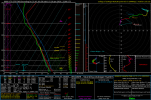
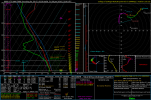
Here's the top analog of the second sounding

Tornado outbreak of November 23–24, 2001 - Wikipedia

jiharris0220
Member
I think you might have gotten confused due to my lack of detail in my wording.Long time lurker here, and I hate to come out of the shadows to be a stickler.
But, this is completely incorrect regarding dew point. What you mentioned is RELATIVE HUMIDITY. Two temperature+moisture combos may have the same RH, but the higher dew point indicates greater moisture content - a higher ABSOLUTE humidity.
Further, the moisture CAPACITY of air is almost exponentially related to actual temperature, with its capacity rapidly increasing above 50F. Meaning, a dewp of 13 is pretty bone-dry, while a dewp of 70 is extremely moist, regardless of the actual air temp and resulting calculated RH.
That said, your analysis of instability is largely spot-on, although the marginal dewps AND temps in this event are leading to the marginal instability. Skew-T CAPE calculation depends upon the intersection of diabatic & adiabatic lapse rates raised from the surface or mixed-layer dewps AND temps, meaning BOTH contribute to the ultimate CAPE calculation. A relatively high temp - say, 80, 85, etc - can compensate for a marginal dewp, but having soupy dewpoints (like low 70s in Dixie in Spring) can make up for a relatively lower temp (say, 75).
This turned into a book - main point is to clear up the definition of dewpoint as well as to clarify that both dewp & temp from surface upwards contribute to the ultimate CAPE calculation. Now, back into the shadows...
Obviously cold air and warm air have entirely different atmospheric physical properties regarding moisture capacity and density, but that’s a whole can of worms that would be a 10+ paragraph essay to explain in detail.
A dew point of 13 and a temp of 20 would be roughly 70% in relative humidity, which is slightly drier compared to a dew point of 70 and a temp of 77. These two points are both 7 degrees away from total saturation.
In terms of absolute humidity, the cold air is physically holding way less moisture since cold air is atomically denser and simply cannot fit any where near as many water molecules as warm air can.
The point was to inform people that low dew point temps doesn’t mean dry air since it’s relative and that vertical temp profile is the main driver of the low cape (in this particular set up) that is all.
Last edited:
I know we saw repeatedly over the summer that STP really doesn't matter all that much when it comes to forecasting tornadoes, but seeing values across this large of an area in the middle of January is just amazing in and of itself.
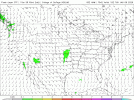
Kds86z
Member
18Z GFS predicts some half-decent CAPE (for January) across AL/GA Saturday afternoon. Wind fields aren't half-bad for the earlier parts of Saturday, but the LLJ really pulls away come the afternoon, so by then you're looking at a pretty marginal risk for tornadoes - not zero, but low (sounding from btw Birmingham and Montgomery). There will be ample moisture in place even in the morning, so if we do get any instability across AL/GA in the morning hours, overlapping with the stronger kinematics, I could see a more robust overnight tornado risk. Overall, highest risk will be on Friday over the Arklamiss with anything that gets going in clusters or as discrete activity in the late afternoon and evening hours. Saturday feels like Marginal or low-end Slight Risk material; conditional but worth keeping an eye on.
View attachment 49695View attachment 49697View attachment 49698View attachment 49696
Definitely seems like a solid nocturnal threat is coming together late Friday night in Alabama. Going to be terrible timing if it comes together.

Justin Hindman
Member
- Messages
- 379
- Reaction score
- 1,167
- Location
- Gardendale Alabama
- Special Affiliations
- SKYWARN® Volunteer
- ARRL Member
I was waiting for him to say tornado outbreak likely
- Moderator
- #151

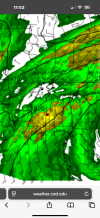
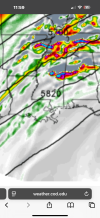
Today’s trend was favorable for MS/AL late Friday afternoon and overnight. Here’s a look at tonight’s RDPS that raises an eyebrow.
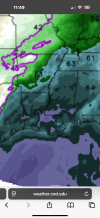
Justin Hindman
Member
- Messages
- 379
- Reaction score
- 1,167
- Location
- Gardendale Alabama
- Special Affiliations
- SKYWARN® Volunteer
- ARRL Member
Charge your phoneToday’s trend was favorable for MS/AL late Friday afternoon and overnight. Here’s a look at tonight’s RDPS that raises an eyebrow.
View attachment 49707View attachment 49708View attachment 49709
Kds86z
Member
THE MARGINAL
RISK AREA HAS BEEN EXPANDED WESTWARD ACROSS OK AND SOUTHERN KS, WITH
RECENT GUIDANCE INDICATING A SLIGHTLY SLOWER SHORTWAVE TIMING. MOST
GUIDANCE SUGGESTS MORNING CONVECTION MAY REMAIN SLIGHTLY ELEVATED,
BUT LOW TORNADO PROBABILITIES MAY EVENTUALLY BE NEEDED IF CONFIDENCE
INCREASES IN SURFACE-BASED STORM DEVELOPMENT FROM CENTRAL OK INTO
SOUTHEAST KS.
WITH TIME, THE MORNING STORMS WILL ENCOUNTER DECREASING BUOYANCY,
BUT IF ORGANIZED CONVECTION CAN BE SUSTAINED, THEN SOME THREAT FOR
LOCALIZED DAMAGING WIND COULD SPREAD TOWARD THE MID MS VALLEY AND
POSSIBLY A LARGER PORTION OF THE MIDWEST AND LOWER OH VALLEY, IN
CONJUNCTION WITH THE EJECTING SHORTWAVE. THE NORTHEAST EXTENT OF
SEVERE POTENTIAL REMAINS UNCERTAIN, WITH THE SHORTWAVE EXPECTED TO
EVENTUALLY OUTPACE RETURNING LOW-LEVEL MOISTURE.
FARTHER SOUTH, SEVERE POTENTIAL BECOMES MORE CONDITIONAL FROM PARTS
OF THE ARKLATEX INTO THE MID-SOUTH, WITH STRONGER ASCENT EXPECTED TO
REMAIN NORTH OF THIS REGION. WHILE BUOYANCY WILL REMAIN WEAK,
LOW-LEVEL AND DEEP-LAYER SHEAR WILL BE STRONG. GUIDANCE REMAINS
INCONSISTENT REGARDING THE DEVELOPMENT OF DEEP CONVECTION IN THIS
REGION, WITH THE ECMWF AND RRFS BEING SOMEWHAT MORE AGGRESSIVE,
WHILE OTHER GUIDANCE IS GENERALLY MORE MUTED. IF ROBUST CONVECTION
CAN DEVELOP WITHIN THIS ENVIRONMENT, THEN SOME THREAT FOR LOCALLY
DAMAGING WIND AND POSSIBLY A TORNADO COULD EVOLVE FROM LATE
AFTERNOON INTO PART OF THURSDAY NIGHT.
RISK AREA HAS BEEN EXPANDED WESTWARD ACROSS OK AND SOUTHERN KS, WITH
RECENT GUIDANCE INDICATING A SLIGHTLY SLOWER SHORTWAVE TIMING. MOST
GUIDANCE SUGGESTS MORNING CONVECTION MAY REMAIN SLIGHTLY ELEVATED,
BUT LOW TORNADO PROBABILITIES MAY EVENTUALLY BE NEEDED IF CONFIDENCE
INCREASES IN SURFACE-BASED STORM DEVELOPMENT FROM CENTRAL OK INTO
SOUTHEAST KS.
WITH TIME, THE MORNING STORMS WILL ENCOUNTER DECREASING BUOYANCY,
BUT IF ORGANIZED CONVECTION CAN BE SUSTAINED, THEN SOME THREAT FOR
LOCALIZED DAMAGING WIND COULD SPREAD TOWARD THE MID MS VALLEY AND
POSSIBLY A LARGER PORTION OF THE MIDWEST AND LOWER OH VALLEY, IN
CONJUNCTION WITH THE EJECTING SHORTWAVE. THE NORTHEAST EXTENT OF
SEVERE POTENTIAL REMAINS UNCERTAIN, WITH THE SHORTWAVE EXPECTED TO
EVENTUALLY OUTPACE RETURNING LOW-LEVEL MOISTURE.
FARTHER SOUTH, SEVERE POTENTIAL BECOMES MORE CONDITIONAL FROM PARTS
OF THE ARKLATEX INTO THE MID-SOUTH, WITH STRONGER ASCENT EXPECTED TO
REMAIN NORTH OF THIS REGION. WHILE BUOYANCY WILL REMAIN WEAK,
LOW-LEVEL AND DEEP-LAYER SHEAR WILL BE STRONG. GUIDANCE REMAINS
INCONSISTENT REGARDING THE DEVELOPMENT OF DEEP CONVECTION IN THIS
REGION, WITH THE ECMWF AND RRFS BEING SOMEWHAT MORE AGGRESSIVE,
WHILE OTHER GUIDANCE IS GENERALLY MORE MUTED. IF ROBUST CONVECTION
CAN DEVELOP WITHIN THIS ENVIRONMENT, THEN SOME THREAT FOR LOCALLY
DAMAGING WIND AND POSSIBLY A TORNADO COULD EVOLVE FROM LATE
AFTERNOON INTO PART OF THURSDAY NIGHT.

Friday
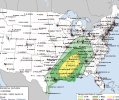
I definitely see atleast a small enchanced coming for Mississippi before Friday gets here.
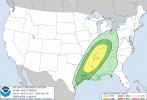
This was the day 3 outlook on 12/8/21. Once again, this isn't a prediction or comparison, just showing a slight risk doesn't necessarily mean this upcoming event has any less potential.
jiharris0220
Member
With the hrrr now in range it’s looking likely this will be a classic high shear, low cape set up. With how low thermos seem to be I doubt durinal heating will do much to evaporate the cumulus field to raise instability.
So far, expect spin up tornadoes, especially along any qlcs segments, some could be strong.
Any discrete development which would be mostly in Arkansas, Tennessee, and Mississippi, could produce a tornado or two before growing upscale.
In the small chance that the cumulus field does manage to evaporate early and allow temps to go into the mid 70s, I would assume the SPC could issue an enhanced risk for the aforementioned states. (This would be a day 1 decision)
So far, expect spin up tornadoes, especially along any qlcs segments, some could be strong.
Any discrete development which would be mostly in Arkansas, Tennessee, and Mississippi, could produce a tornado or two before growing upscale.
In the small chance that the cumulus field does manage to evaporate early and allow temps to go into the mid 70s, I would assume the SPC could issue an enhanced risk for the aforementioned states. (This would be a day 1 decision)

There is room for a level 3 enhanced introduction plus I'm beginning to get more concerned about the flash flooding aspect as well. So we have dual threat: severe weather/tornadoes and heavy rain/flash flooding.
Trey is going live tonight at 7
Shreveport was talking about how sheer vectors are unidirectional on Friday which will limit severe potential. The NAM is the only model showing counter clockwise rotation with height which is why it's presenting a much more severe outlook.