• Welcome to TalkWeather!
    We see you lurking around TalkWeather! Take the extra step and join us today to view attachments, see less ads and maybe even join the discussion.
    CLICK TO JOIN TALKWEATHER

Severe Weather 2026

We are entering that time of year, particularly across the Deep South, where the RRFS, NAM, and HRRR are pretty much useless with forecasting storms unless there's a MCS and/or tropical system involved.
 
We are entering that time of year, particularly across the Deep South, where the RRFS, NAM, and HRRR are pretty much useless with forecasting storms unless there's a MCS and/or tropical system involved.
Boring time year I say pretty much from
My perspective. Waiting on secondary severe season for me now .
 
Last edited:
Because of pop up isolated storms each day. All three struggle immensely with Summer time convection.
While the practical utility would be limited, being able to forecast pulse multicell storms in summertime climates would be a really neat and impressive feat for CAMs.
 
I'm not one to hold grudges. A few weeks ago, a major issue occurred on this forum with site members being stripped of their supporting membership and other remarks were thrown back and forth etc etc. I won't go into these details because it's been talked about many times and many members have got the gist of it.

I have been unbanned because many members including @Grand Poo Bah were heavy advocates for me to get unbanned and i deeply appreciate that mini "protest" if you will.

I could've done better with my statement and some stuff I certainly could've toned down in a more respectful manner, but to the mods that were involved in that message to Mike and Wes:

This situation could've been handled better from both sides. There were lessons learned, and my message were purely made up of pent up frustrations from decisions that pissed me off. I hold no grudges against you two, and my feelings remain the same even now about what happened, but i wish to move on and to be given a second chance somewhat is showing the trust. I wouldn't consider this a apology in anyway, because I felt my statement had backing to it but it's irrelevant and in the past so on we go. If a situation like this ever occurs again, hopefully us members can have a discussion that wasn't as heated or got to a tempting point as last time. This is moreso a oversight on the situation. That being said

The Leprechaun is back. Things happen. It got a bit over the top, but now things have calmed down and we can start anew. My posts however will be likely less regular if anything and strictly limited to more higher end events or ongoing events.
 
I'm not one to hold grudges. A few weeks ago, a major issue occurred on this forum with site members being stripped of their supporting membership and other remarks were thrown back and forth etc etc. I won't go into these details because it's been talked about many times and many members have got the gist of it.

I have been unbanned because many members including @Grand Poo Bah were heavy advocates for me to get unbanned and i deeply appreciate that mini "protest" if you will.

I could've done better with my statement and some stuff I certainly could've toned down in a more respectful manner, but to the mods that were involved in that message to Mike and Wes:

This situation could've been handled better from both sides. There were lessons learned, and my message were purely made up of pent up frustrations from decisions that pissed me off. I hold no grudges against you two, and my feelings remain the same even now about what happened, but i wish to move on and to be given a second chance somewhat is showing the trust. I wouldn't consider this a apology in anyway, because I felt my statement had backing to it but it's irrelevant and in the past so on we go. If a situation like this ever occurs again, hopefully us members can have a discussion that wasn't as heated or got to a tempting point as last time. This is moreso a oversight on the situation. That being said

The Leprechaun is back. Things happen. It got a bit over the top, but now things have calmed down and we can start anew. My posts however will be likely less regular if anything and strictly limited to more higher end events or ongoing events.
I ask about u. Glad see u back
 

The climate is definitely changing, and I think this year has been the biggest proof of that in probably years. While Iowa and Kansas have been quite normal, having Illinois being the leading state of tornadoes this year with over 100+ in late May is not normal. Not to mention, having Wisconsin seeing 25+ tornadoes (which is top 10) is also not normal.

This is also not mentioning Michigan seeing a couple strong tornadoss in early March, and just the overall activeness the midwest has had.

Tornado Alley has definitely shifted eastward, and this year I think is the biggest proof of that.

Will be interesting to see how the rest of the year progresses.
 
The climate is definitely changing, and I think this year has been the biggest proof of that in probably years. While Iowa and Kansas have been quite normal, having Illinois being the leading state of tornadoes this year with over 100+ in late May is not normal. Not to mention, having Wisconsin seeing 25+ tornadoes (which is top 10) is also not normal.

This is also not mentioning Michigan seeing a couple strong tornadoss in early March, and just the overall activeness the midwest has had.

Tornado Alley has definitely shifted eastward, and this year I think is the biggest proof of that.

Will be interesting to see how the rest of the year progresses.
Some decent points here.

I really don’t buy a “traditional tornado alley”, it seems each section (Ohio Valley, Dixie, Midwest, Traditional Plains) have really busy periods and then quiet periods. This has been a trend throughout history.

The one thing I will say that I do believe has changed are the frequency of these very quiet years. 2015 through 2018, and now 2026. There was never a period like 2018 in the historical record, and we are one Enid Oklahoma storm away from possibly having a second one like that in fewer than 10 years. While the past couple of years have been really active, it does seem like those “bu$t years” are more frequent now.

Now, I’m not making the same arguments like he-who-should-not-be-named. I don’t think tornados are getting weaker or high end outbreaks going extinct. Quite the opposite, 2025 was a headliner year. Plus all the subjectivity and flaws involved with our current EF scale vs the F scale. We are going on 12 years since the last time there were 4 or more violent tornados in 4 days per Broyle’s violent tornado web page. That is the longest streak in history, second was 10 years from the 1930s to early 1940s. If Springfield was competent, and Bakersfield rightfully got its EF4, that streak would’ve ended last year on 3/14-3/15. So I think that specific streak comes down to how bats*** our ratings are now.

The more Frequent below average/quiet years does seem to be something that could be changing. Unless we are just in a 1930s like cycle right now.
 
Certainly, all of us members on here have only been alive long enough at most several decades of severe weather. I think we have such a myopic view of what tornado frequency should look like because of those “poster-child years” we discuss so often, that we forget that it is likely a larger climatological normalcy to see a higher average of slower seasons than what we’ve been accustomed to.
 
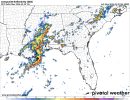
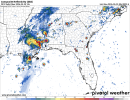
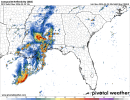
Here's a perfect example of why the short range models aren't useful at this time of year outside of the MCS/tropical stuff I mentioned yesterday. Here's the 00z RRFS, HRRR, and 3km NAM all valid at 1pm today. What do you see? Absolutely nothing where it is currently pouring
 

Attachments

  • refcmp.us_se.png (1pm currently).png
    refcmp.us_se.png (1pm currently).png
    385.1 KB · Views: 8
  • refcmp.us_se.png (1pm today).png
    refcmp.us_se.png (1pm today).png
    392.8 KB · Views: 8
  • refcmp.us_se.png (1pm Mon. today).png
    refcmp.us_se.png (1pm Mon. today).png
    385.2 KB · Views: 6
Some decent points here.

I really don’t buy a “traditional tornado alley”, it seems each section (Ohio Valley, Dixie, Midwest, Traditional Plains) have really busy periods and then quiet periods. This has been a trend throughout history.
You actually need to provide some evidence for this assertion though. Sure you can make claims like tornadoes being less detectable in the forested south (so you could look at significant events) but that would need to be balanced with things like the lower detectability of night plains events.

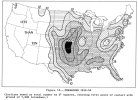
In any case, what data we do have generally shows the plains being the most active. For example this one published in 1960 shows a similar plains-heavy distribution to those produced for the second half of the century:

Screen Shot 2026-05-26 at 7.10.44 am.png
 
You actually need to provide some evidence for this assertion though. Sure you can make claims like tornadoes being less detectable in the forested south (so you could look at significant events) but that would need to be balanced with things like the lower detectability of night plains events.

In any case, what data we do have generally shows the plains being the most active. For example this one published in 1960 shows a similar plains-heavy distribution to those produced for the second half of the century:

View attachment 53048
Considering how spotty and recent our records of tornados are, what you’re saying can be classified as conjecture as well. If we had 300 years of concrete actual tornado counts and data, sure. With that absence, can we really say “tornado alley” has always been “tornado alley”? That it’s not possible that was just a bias and that there are specific foci of tornadic activity in multiple parts of the US?

Something published in 1960 like that is going to have data quality and plains bias issues. Especially when, as you noted, only significant tornado events are going to be documented for regions outside of the plains because of either being rain wrapped or visibility issues.

I’ll give you this, the inability of Oklahoma in recent years to produce a diurnal upper caliber outbreak is notable and I’ve commented on it myself. It’s no longer a guarantee if you book a chasecation out to Oklahoma in May for two weeks that you’ll see tornados. Those conditional producing and dry line days that the plains were well known for also seem to be rarer and rarer. Whether that’s something cyclic, or if it’s something to do with a warming climate, no one can say one way or the other definitively.

Edit: a word
 
Last edited:
Considering how spotty and recent our records of tornados are, what you’re saying can be classified as conjecture as well. If we had 300 years of concrete actual tornado counts and data, sure. With that absence, can we really say “tornado alley” has always been “tornado alley”? That it’s not possible that was just a bias and that there are specific focuses of tornadic activity in multiple parts of the US?

Something published in 1960 like that is going to have data quality and plains bias issues. Especially when, as you noted, only significant tornado events are going to be documented for regions outside of the plains because of either being rain wrapped or visibility issues.

I’ll give you this, the inability of Oklahoma in recent years to produce a diurnal upper caliber outbreak is notable and I’ve commented on it myself. It’s no longer a guarantee if you book a chasecation out to Oklahoma in May for two weeks that you’ll see tornados. Those conditional producing and dry line days that the plains were well known for also seem to be rarer and rarer. Whether that’s something cyclic, or if it’s something to do with a warming climate, no one can say one way or the other definitively.

The weird thing about midwestern/deep south tornadoes is that I feel they should not be harder to document. They have more damage to pull off, as they are substantially more inhabited than the plains. However, I do recall an early fujita scale discussion noting that dixie was observed much later than the traditional tornado alley. Which does make me wonder if there is something that has made it harder to document tornadoes in that region. Rather it'd be the aforementioned rain wrapping that a lot of tornadoes seem or darker reasons like tornadoes not being confirmed in african american communities.
 
Considering how spotty and recent our records of tornados are, what you’re saying can be classified as conjecture as well. If we had 300 years of concrete actual tornado counts and data, sure. With that absence, can we really say “tornado alley” has always been “tornado alley”? That it’s not possible that was just a bias and that there are specific focuses of tornadic activity in multiple parts of the US?

Something published in 1960 like that is going to have data quality and plains bias issues. Especially when, as you noted, only significant tornado events are going to be documented for regions outside of the plains because of either being rain wrapped or visibility issues.
You say this, but you're using the relatively low data quality to argue for your preferred pattern even though you have even less evidence for that. You've also jumped from the possibility of events in certain places being less detectable to 'only sig events will be recorded outside the plains'. My only suggestion was that making comparisons using sig events could be more robust, though it could be more biased against western areas (less to hit). What data we do have are consistent with the plains being the normal locus of activity.

I’ll give you this, the inability of Oklahoma in recent years to produce a diurnal upper caliber outbreak is notable and I’ve commented on it myself. It’s no longer a guarantee if you book a chascation out to Oklahoma in May for two weeks that you’ll see tornados. Those conditional producing and dry line days that the plains were well known for also seem to be rarer and rarer. Whether that’s something cyclic, or if it’s something to do with a warming climate, no one can say one way or the other definitively.
People have proposed possible changes with global warming that could be consistent with both an eastward change in distribution and the night-biased nature of recent plains events, such as a stronger EML, reduced low lapse rates and increased wind shear. These ideas aren't coming from nothing.
 
Back
Top