• Welcome to TalkWeather!
    We see you lurking around TalkWeather! Take the extra step and join us today to view attachments, see less ads and maybe even join the discussion.
    CLICK TO JOIN TALKWEATHER

Hurricane & Tornado Anniversaries

Today marks 13 years since the 2013 Moore EF5.


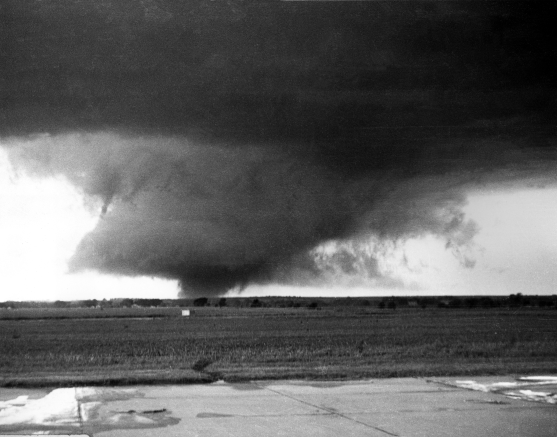
It's also the anniversary of the 1957 Ruskin Heights F5 tornado, which killed 44 people in the Kansas City area.


NWS Summary of the tornado


20may57_01.png

Photo of the tornado taken from the Ottawa, KS airport.

It still baffles my mind how quickly the Moore tornado went from a stove pipe to a full fledged wedge in such a short amount of time.
 
Ah yes, the film of the Cordell tornado was in just about every tornado documentary (along with the video from the early '90s Hesston and Andover outbreaks) I saw growing up. Later I read about the day in Gary England's book, and how he was ordered not to use KWTV's newly installed (at his urging), cutting-edge Doppler radar to cover the storms because the station didn't yet have an FCC license to operate it. He also described the live crew's view of the formation of the Binger wedge, which was on a course to threaten parts of the OKC metro but fortunately occluded and dissipated.
 
The Totable Tornado Observatory (TOTO) was deployed at least a couple times during that outbreak, but on every occasion the tornado in question missed the probe. Binger is especially notable as the tornado made a lefthand jog just shy of TOTO's position, and would've likely struck it had it remained on course for at least a couple more minutes instead.

However, sometime after this outbreak, wind tunnel tests were conducted on TOTO, and it found a major weakness in the design: It was rather top heavy. If the probe was unanchored (as was the case on its deployments), it would tip over in winds just over 100 MPH (thus leaving it practically useless for studying F2+ tornadoes--the same type of tornadoes that cause the great majority of death and destruction); however, if it was anchored, it could withstand winds over 300 MPH (upper-end F5) to at least a reasonable degree. However, deploying the 400-pound (180-kilogram) device under its then-current configuration was already considered a nerve-wracking endeavor as it was, and it would need some serious reworking to equip it with some kind of anchoring system (preferably one that could be rapidly deployed). Indeed, the only time it was actually struck (or rather sideswiped in this case) by a tornado in 1983, the crew found it tipped over on its side.

Given the notable strength of the Binger tornado, had it struck TOTO as intended, the probe would've almost certainly been knocked over. Perhaps the top-heavy issue would've been discovered earlier in that case, though what effects (if any) that would have on future operations we can only speculate on...
 
Today is the 15th anniversary of the 5/24/2011 outbreak which featured the absolute monster El Reno EF5, and two very arguable additional EF5 candidates in Chickasha and Goldsby.

Those tornados etched 5/24 into the book with other diurnal and visible epic plains outbreaks such as 4/26/91 and 5/3/99. Oklahoma hasn’t seen anything remotely close to that caliber of event since then. Although there have been many after dark storms, the infamous 5/20/19 bu$t, and the 2013 Moore and El Reno storms.
 
Today is the 15th anniversary of the 5/24/2011 outbreak which featured the absolute monster El Reno EF5, and two very arguable additional EF5 candidates in Chickasha and Goldsby.

Those tornados etched 5/24 into the book with other diurnal and visible epic plains outbreaks such as 4/26/91 and 5/3/99. Oklahoma hasn’t seen anything remotely close to that caliber of event since then. Although there have been many after dark storms, the infamous 5/20/19 bu$t, and the 2013 Moore and El Reno storms.
It’s also the anniversary of the 1973 Union City F5 that for some reason Grazulis moved down by a rating and that the NWS rolled with.
 
Today is the 15th anniversary of the 5/24/2011 outbreak which featured the absolute monster El Reno EF5, and two very arguable additional EF5 candidates in Chickasha and Goldsby.

Those tornados etched 5/24 into the book with other diurnal and visible epic plains outbreaks such as 4/26/91 and 5/3/99. Oklahoma hasn’t seen anything remotely close to that caliber of event since then. Although there have been many after dark storms, the infamous 5/20/19 bu$t, and the 2013 Moore and El Reno storms.
Wow a few violent tornadoes in ok on one day
 
Today marks the anniversaries of at least two notable (if not major) tornado events:

First is the tornado outbreak that struck Alabama on this date in 1973, of which the most infamous tornado was the F4 that struck Centreville and Brent. It even managed to tear off the antenna of the Centreville WSR-57 (though thankfully it was repaired in time for the 1974 Super Outbreak just shy of a year later). Interestingly, this wouldn't be the last time that radar was hit by a tornado, as another one that occurred on March 25, 2021, tore off the radome (though sparing the antenna this time); however, the radar had long been decommissioned by that point.

Second is the tornado outbreak that struck eastern Texas on this date in 1997. It was highly unusual, occurring in a "high CAPE/low shear" environment with an insanely unstable atmosphere but very little vertical change in either wind speed or wind direction. Nonetheless, an interaction of several boundaries (especially a cold front, a dryline, and an outflow boundary) provided enough of a source of low level vorticity that the storms that fired along that confluence were able to produce spectacular, slow-moving tornadoes that moved northeast to southwest (the opposite direction tornadoes usually travel in).

The most infamous of these tornadoes struck the Double Creek Estates subdivision of Jarrell. The combination of extremely strong winds, large diameter (around half a mile wide, give or take), a slow translational speed (which led to long-duration exposure to said winds), and the affected buildings having highly variable but generally poor build quality all led to some of the most extreme damage that a tornado has ever been recorded to produce. The tornado, which garnered an F5 rating as a result, killed 27 people and injured 12--a darkly noteworthy achievement, given that most mass-casualty tornadoes usually tend to produce more injuries than fatalities.
 
Today marks the anniversaries of at least two notable (if not major) tornado events:

First is the tornado outbreak that struck Alabama on this date in 1973, of which the most infamous tornado was the F4 that struck Centreville and Brent. It even managed to tear off the antenna of the Centreville WSR-57 (though thankfully it was repaired in time for the 1974 Super Outbreak just shy of a year later). Interestingly, this wouldn't be the last time that radar was hit by a tornado, as another one that occurred on March 25, 2021, tore off the radome (though sparing the antenna this time); however, the radar had long been decommissioned by that point.

Second is the tornado outbreak that struck eastern Texas on this date in 1997. It was highly unusual, occurring in a "high CAPE/low shear" environment with an insanely unstable atmosphere but very little vertical change in either wind speed or wind direction. Nonetheless, an interaction of several boundaries (especially a cold front, a dryline, and an outflow boundary) provided enough of a source of low level vorticity that the storms that fired along that confluence were able to produce spectacular, slow-moving tornadoes that moved northeast to southwest (the opposite direction tornadoes usually travel in).

The most infamous of these tornadoes struck the Double Creek Estates subdivision of Jarrell. The combination of extremely strong winds, large diameter (around half a mile wide, give or take), a slow translational speed (which led to long-duration exposure to said winds), and the affected buildings having highly variable but generally poor build quality all led to some of the most extreme damage that a tornado has ever been recorded to produce. The tornado, which garnered an F5 rating as a result, killed 27 people and injured 12--a darkly noteworthy achievement, given that most mass-casualty tornadoes usually tend to produce more injuries than fatalities.
One thing that baffles me about the Jarrell tornado is how it started out as a landspout and then attatched itself to the mesocyclone of the parent thunderstorm.
 
One thing that baffles me about the Jarrell tornado is how it started out as a landspout and then attatched itself to the mesocyclone of the parent thunderstorm.

Didn't Greenfield 2024 do something similar? Maybe not exactly a common occurrence, but more common than we think, and it can birth some real monsters.
 
13 years since the widest tornado in history. 13 years since we lost some of the best chasers in history. The 2013 El Reno tornado was a storm that had a target on anyone who chased it.
 
Back
Top