jackhutwx
Member
that still really annoys me, I mean you have arguably one of the worst warnings you can get, and the vrot wasnt even justifiable (if im correct), neither was there an actual tornado confirmed.
Follow along with the video below to see how to install our site as a web app on your home screen.
Note: This feature may not be available in some browsers.


If this is the home I'm thinking of, keep in mind that a major failmode existed in the fact that it was built partially on stilts. Once those went the entire thing would have easily been pushed up and off the foundation due to upward wind motion. Additionally any concrete foundation failing in a tornado is a sign of issues with the foundation itself, not the strength of the tornado.The anchoring on the home obliterated by the St. Libory-Palmer tornado was so excellent that the concrete foundation failed before the anchoring itself. Been a while since we've seen one of these.
View attachment 52991
If this is the home I'm thinking of, keep in mind that a major failmode existed in the fact that it was built partially on stilts. Once those went the entire thing would have easily been pushed up and off the foundation due to upward wind motion. Additionally any concrete foundation failing in a tornado is a sign of issues with the foundation itself, not the strength of the tornado.
I'm not saying it's a terrible DI or anything, just meh.
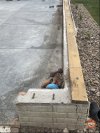
Main part of the home, per DAT:What I see in this pic is a poured concrete foundation with perfectly spaced anchor bolts.
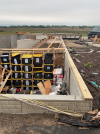
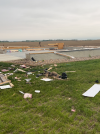
Anchoring still doesn't seem all that terrible on the home. Looks very similar actually, with the corners having closer spaced bolts as opposed to the more spaced out walls.Main part of the home, per DAT:
View attachment 52995
View attachment 52996
The section where the concrete failed is a garage.
View attachment 52997
Personally this is an EF3 indicator at the maximum; I'm just not comfortable with it being any higher given the major failmode on this home. If there wasn't a giant opening at the lowest level I could see higher but that's a hypothetical.Anchoring still doesn't seem all that terrible on the home. Looks very similar actually, with the corners having closer spaced bolts as opposed to the more spaced out walls.
But that front part (what appears to be a walk out basement) is kinda definitive as a failiure area. I'm not exactly the best in terms of rating damage but they could go LE EF-4 if they want to go all in, but IDK. Id be fine with HE EF-3
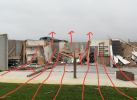
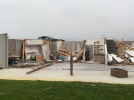
It was also found earlier today that one of the homes was directly in the core and poorly anchored yet was not completely destroyed; this very much makes me suspicious that it was not as powerful as it looked visually.Yeah so this is a textbook example of the presence of bolts alone sometimes not automatically equaling violent damage. What mainly happened here is catastrophic failure of the home’s wood frame walkout basement wall. This huge weak point, combined with the overhang and movement of the tornado actually allowed the full force of the winds to rush into the home’s basement. This creates a brutal, explosive wrenching upward force on the home’s joists and subflooring that makes the home’s basement level essentially “pop” like a balloon. This literally pops the joists and floor right off the bolts, and launches the entire home off the foundation. Basement garages can result in the same phenomenon. Another big tell is that multiple homes immediately downwind from this home still had some walls left standing, which is a contextual clue. Also as pointed out above, the broken concrete was on a detached garage near the house, not the house itself.
Keen observers may point out that one of the Elkhorn, NE homes failed in a similar manner but was still rated EF4. But the big difference there was the movement of the tornado, which was approaching from the front side of the house. The St. Libory tornado approached and struck the back side of the house, meaning wind got under the overhang and the walkout basement wall was directly broadsided and blown inward, not outward.
The result? High-end EF3 is technically acceptable here, even though I’m typically a stickler for 170+ MPH when a bolted home is swept away.
Yeah that right there is a huge clue. That’s why I mentioned the immediate downwind homes from the totally obliterated one. They still had some walls standing, which is one of the first things that made me say “hmmmm” when I saw the aerial flyover of the subdivision.It was also found earlier today that one of the homes was directly in the core and poorly anchored yet was not completely destroyed; this very much makes me suspicious that it was not as powerful as it looked visually.

Parkersburg involved failure of reinforced poured concrete stem walls and cracking of the concrete floor (I disagree that any damage to foundation concrete is automatically representative of a structural flaw, especially when reinforcement is present). It was so thoroughly swept that there was no discernible or traceable debris pattern extending away from the home, what little debris that remained was granulated down to coin sized fragments, and grass scouring occurred in the immediate vicinity. I’m also pretty sure the walkout wall was perpendicular to the tornado’s movement in Parkersburg, meaning it wasn’t broadsided, so the explosive failure of the joists likely wasn’t as big of a factor. In addition, surveyors stated that construction quality of the golf course homes was well above the standard needed for EF5 in Parkersburg. So while it may seem similar at a glance, it’s a totally different ballgame circumstantially, structurally, and contextually.Can someone explain to me the difference in failure mode between this home and the infamous walk-out basement home in Parkersburg?
Obviously Parkersburg was a far more violent tornado - I just genuinely don't understand. Does it boil down to overall context?
Thanks for the explanation.Parkersburg involved failure of reinforced poured concrete stem walls and cracking of the concrete floor (I disagree that any damage to foundation concrete is automatically representative of a structural flaw, especially when reinforcement is present). It was so thoroughly swept that there was no discernible or traceable debris pattern extending away from the home, what little debris that remained was granulated down to coin sized fragments, and grass scouring occurred in the immediate vicinity. I’m also pretty sure the walkout wall was perpendicular to the tornado’s movement in Parkersburg, meaning it wasn’t broadsided, so the explosive failure of the joists likely wasn’t as big of a factor. In addition, surveyors stated that construction quality of the golf course homes was well above the standard needed for EF5 in Parkersburg. So while it may seem similar at a glance, it’s a totally different ballgame circumstantially, structurally, and contextually.
The St. Libory home just had a wooden walkout wall blown in, without any other parallels besides the type of basement foundation.
Exactly! I was re-looking over footage of the tornado this morning and I can see no discernible shift in visual intensity from that property to the bolted home, which I geolocated a few days ago. I do think it was intense and that the EF3 rating is justifiable, I just don't see anything higher than that (EF4+) being realistic.Sure one could argue, “well maybe that one home experienced way more intense winds than the others”, but the totality of the evidence suggests it had more to do with a fatal construction flaw combined with the movement/approach of the tornado.
Exactly! I was re-looking over footage of the tornado this morning and I can see no discernible shift in visual intensity from that property to the bolted home, which I geolocated a few days ago. I do think it was intense and that the EF3 rating is justifiable, I just don't see anything higher than that (EF4+) being realistic.
This is also why I don't factor photogrammetry or DOW into my ratings, as photogrammetry relies on visual winds (which, as seen here, are sometimes not as intense as they appear); DOW got instantaneous winds of 224 mph in this tornado and I don't see any damage that would support this in a 3-second sense. I'll also note that leading up to the property EF2-range winds were deduced from cycloidal marks, although I myself am generally a skeptic so take that as you will.

My pushback to that is that there have been wind load studies done using actual houses inside warehouses (I think it was the... USC? who did it iirc) and the EF scale generally seemed to align with the degree of damage sustained in the cooresponding winds. They also simulated a completely unanchored home and it actually slid off the foundation and fell apart in ~110 mph winds; on the F scale that would probably be an F3+ indicator.View attachment 53013
224 mph would be a low end F4 on the old scale which seems to line up with the damage we're seeing.
I think I’ve seen that on a TV show but I can’t remember which one.My pushback to that is that there have been wind load studies done using actual houses inside warehouses (I think it was the... USC? who did it iirc) and the EF scale generally seemed to align with the degree of damage sustained in the cooresponding winds. They also simulated a completely unanchored home and it actually slid off the foundation and fell apart in ~110 mph winds; on the F scale that would probably be an F3+ indicator.
I'd need to see more research done on it before having an opinion though.
I'm calling bs. There were both no EMA reports at the time of the supposed "tornado" and radar didn't show jack. Sounds like they're trying to cover it up to me.View attachment 53074View attachment 53075
The NWS "confirmed" a "tornado" on the unconfirmed tornado emergency on the 18th.
...yeah right.