• Welcome to TalkWeather!
    We see you lurking around TalkWeather! Take the extra step and join us today to view attachments, see less ads and maybe even join the discussion.
    CLICK TO JOIN TALKWEATHER

Severe Weather Threat May 16-18, 2026

The LLJ right now is around 30knots, considering the storms are moving northeast at 35knots, they’re feeling even less shear than even that.
By the time the LLJ intensifies to the point that’s actually favorable for tornadogenises, these supercells will be upscale.
I held my tongue on this setup for a while, but this is exactly why cold front setups hardly ever produce significant tornado outbreaks, at all.
Never understood why the SPC issued a tornado driven moderate risk, let alone a PDS watch, when it was blatantly obvious for days that the cold front plus it’s parallel orientation with the deep layer wind shear vector would cause rapid upscale growth well before any appreciable intensification of the LLJ occurred for supercells to actually take advantage of kinematics.
Obviously it’s early, perhaps a favorable mesoscale interaction can manage to squeeze an sig tor, but I couldn’t help but shake my head seeing the “several strong tornadoes” likely tag knowing that it wouldn’t pan out.
But again, it’s still early, and these two supercells still have a limited window of at least 2 hours coinciding with a strengthening LLJ and baring any mesoscale interaction to produce sig tors.
But, at this point, it looks likely that this will now be the second moderate of the year that will feature only one or two weak tornadoes.
Other than the setup that produced the Enid twister and those two Dixie alley twin ef3s, every single one has been sh&t, and it’s been easy to tell before hand with every single one at least a day out. 2026 still on track to be the year of the b#st.
 
The LLJ right now is around 30knots, considering the storms are moving northeast at 35knots, they’re feeling even less shear than even that.
By the time the LLJ intensifies to the point that’s actually favorable for tornadogenises, these supercells will be upscale.
I held my tongue on this setup for a while, but this is exactly why cold front setups hardly ever produce significant tornado outbreaks, at all.
Never understood why the SPC issued a tornado driven moderate risk, let alone a PDS watch, when it was blatantly obvious for days that the cold front plus it’s parallel orientation with the deep layer wind shear vector would cause rapid upscale growth well before any appreciable intensification of the LLJ occurred for supercells to actually take advantage of kinematics.
Obviously it’s early, perhaps a favorable mesoscale interaction can manage to squeeze an sig tor, but I couldn’t help but shake my head seeing the “several strong tornadoes” likely tag knowing that it wouldn’t pan out.
But again, it’s still early, and these two supercells still have a limited window of at least 2 hours coinciding with a strengthening LLJ and baring any mesoscale interaction to produce sig tors.
But, at this point, it looks likely that this will now be the second moderate of the year that will feature only one or two weak tornadoes.
Other than the setup that produced the Enid twister and those two Dixie alley twin ef3s, every single one has been sh&t, and it’s been easy to tell before hand with every single one at least a day out. 2026 still on track to be the year of the b#st.
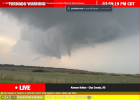
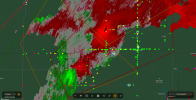
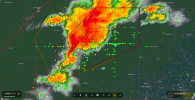
And just as I was typing this, the scenario of a favorable meso interaction has come to somewhat salvage this moderate risk, there’s a weak nudger cell helping the parent cell producing an adequate RFD, which could succeed to produce a tornado, and possibly a sig tor at that.
1779138459321.png
 
Please stop. If you really believe that, give some data to back up why you think that.
Its pretty obvious at this point. Shear is lacking/parallel to the boundary and storms are super clustered. Almost 4 hours into the PDS Watch and there really hasn't been anything of note. There also seems to be some moisture issues. Everything about how the first 4 hours of this event has evolved tells you that its not going to reach its ceiling. Its fine to start questioning things.
 
Last edited:
Next 30-45 minutes are going to be really interesting to me and will probably make or break this watch and outlook.

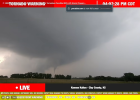
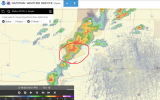
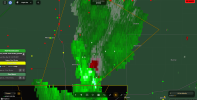
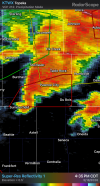
The storm nearing Hanover has started to rotate again and is about to undergo further cell mergers. The Morganville storm is about to undergo another merger and may get nudged by the stronger updraft to its SW.

Meanwhile, the two cells further to their SW are becoming more semi-discrete and are beginning to rotate. Andy Hill just highlighted that those storms are in an STP 8 environment.
 
Its pretty obvious at this point. Shear is lacking/parallel to the boundary and storms are super clustered. Almost 4 hours into the PDS Watch and there really hasn't been anything of note. There also seems to be some moisture issues. Everything about how the first 4 hours of this event has evolved tells you that its not going to reach its ceiling. Its fine to start questioning things.
The moisture is fine (where the moderate risk is located) the fail mode today is the fact that storms had to somehow remain adequately spaced in a cold front forced environment long enough for the nocturnal LLJ to kick in, which was obviously going to be a long shot at best and surprise surprise, it’s almost all upscale before 5pm, and the LLJ won’t kick in until the classic 7pm timeframe.

A moderate risk would’ve been justified had the 500mb jet streak were further south as to allow for a stronger surface low to develop so the cold front would’ve been more north/south aligned and for a strong LLJ to be present throughout the day without having to wait for one to develop.

What’s stranger is that the SPC is obviously aware of these things, and literally pointed these things out in everyone of their outlooks, and yet they went with a CIG2 moderate risk anyways, and went as far as to issue an 80/80PDS watch???
 
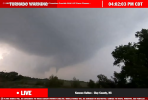
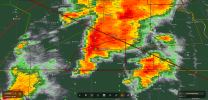
That storm nearing Pawnee City, Nebraska has also consolidated multiple updrafts and become discrete. I would be increasingly concerned about this storm over the next 30-45 minutes.
 

Attachments

  • IMG_4682.png
    IMG_4682.png
    1.1 MB · Views: 3
Back
Top