• Welcome to TalkWeather!
    We see you lurking around TalkWeather! Take the extra step and join us today to view attachments, see less ads and maybe even join the discussion.
    CLICK TO JOIN TALKWEATHER

Severe Weather 2026

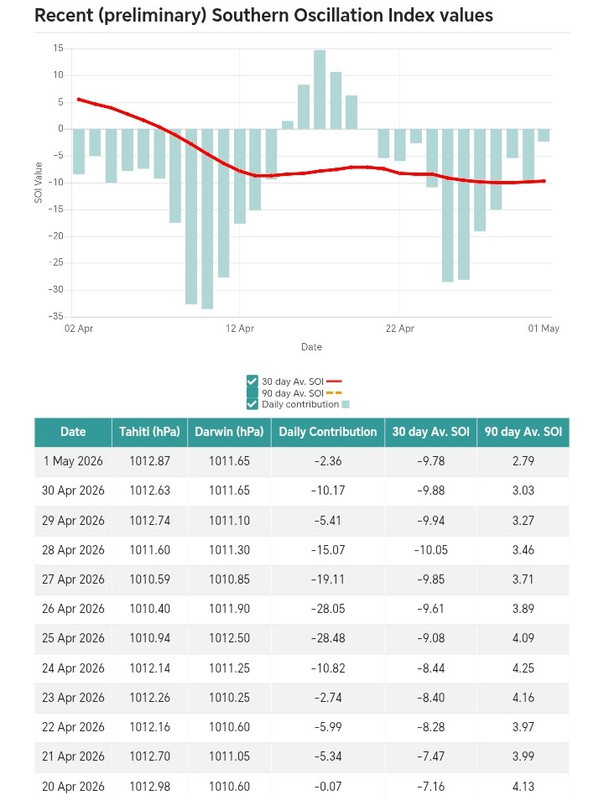
Southeastern South America (hereinafter referred to as SESA) has experienced several episodes of severe weather so far this month due to a series of unusually intense jet streaks and short- and long-wave troughs at 500–300 hPa, most likely resulting from the recent El Niño-driven atmosphere-ocean coupling, as indicated by negative SOI indices:
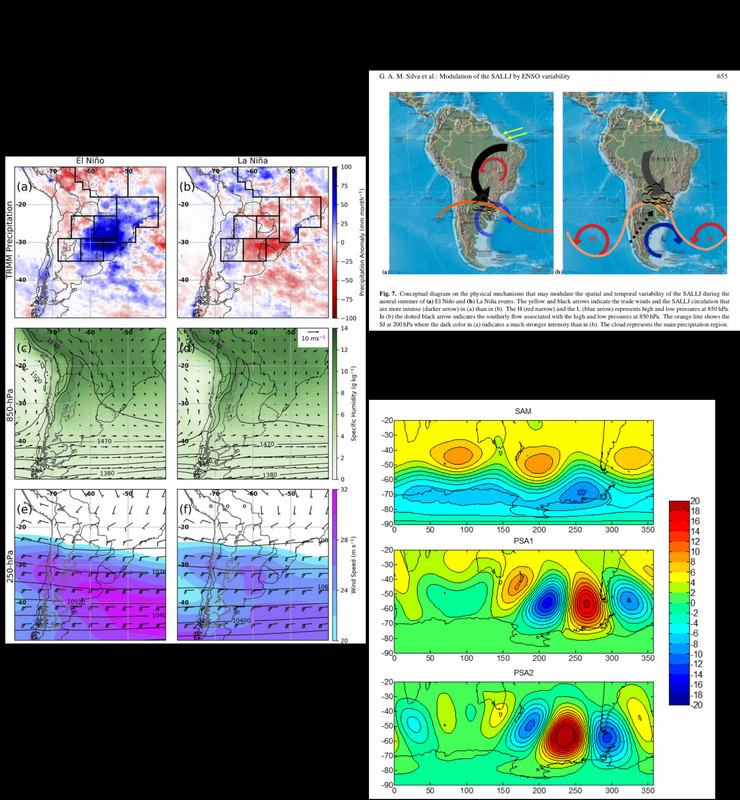
(Perhaps in another post I discussed El Niño teleconnections in South America in greater depth; they essentially act as a powerful catalyst for severe weather and tornadoes in the SESA region)...

[1/4]
 
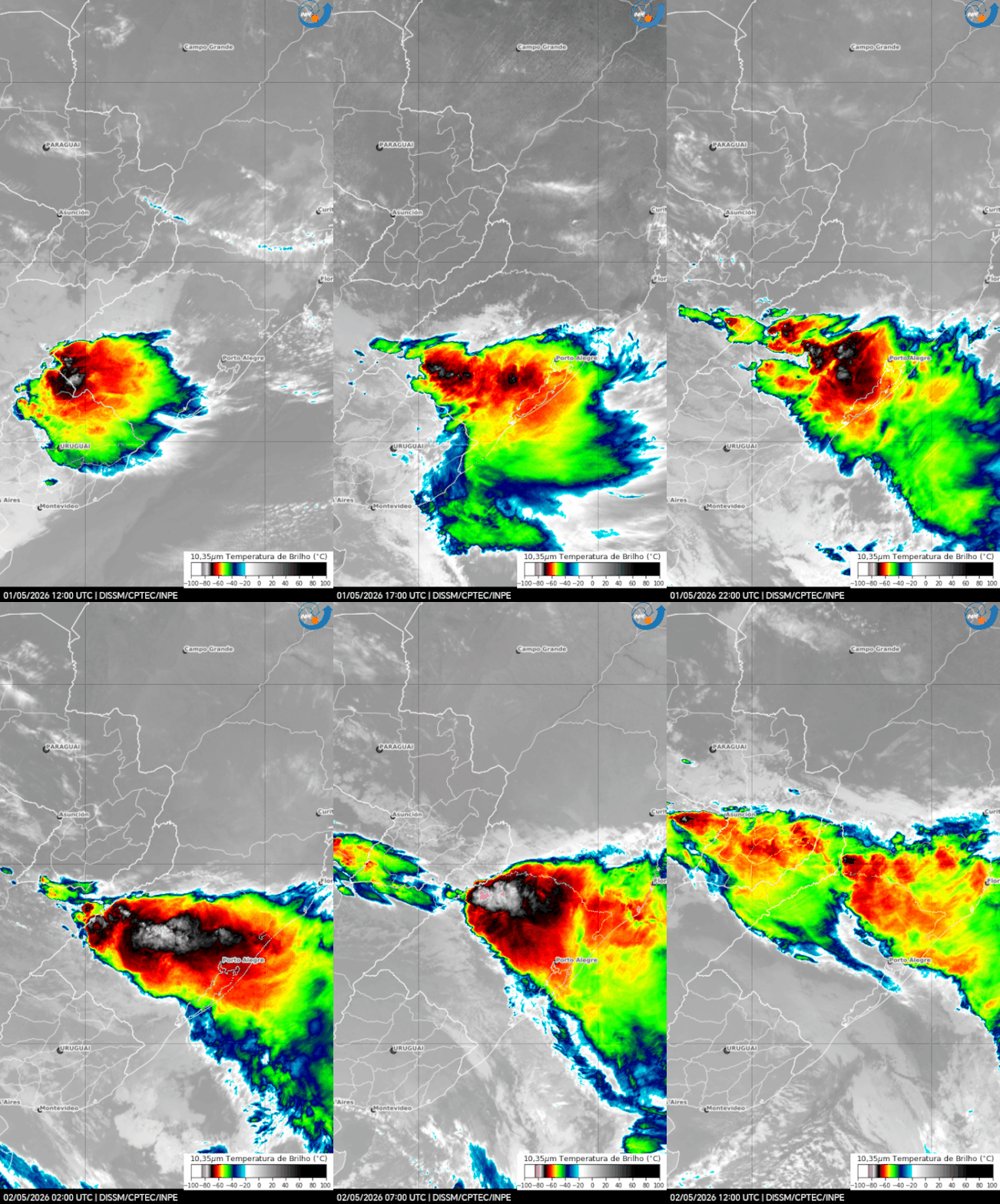
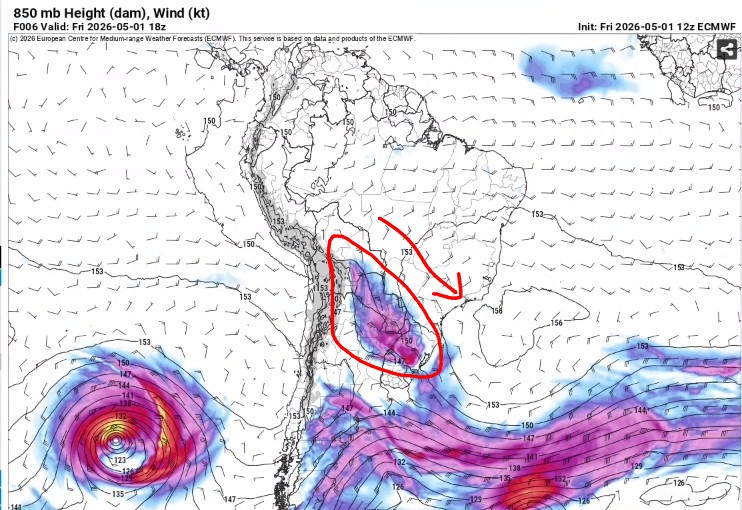
05/01/26 - 05/02/26

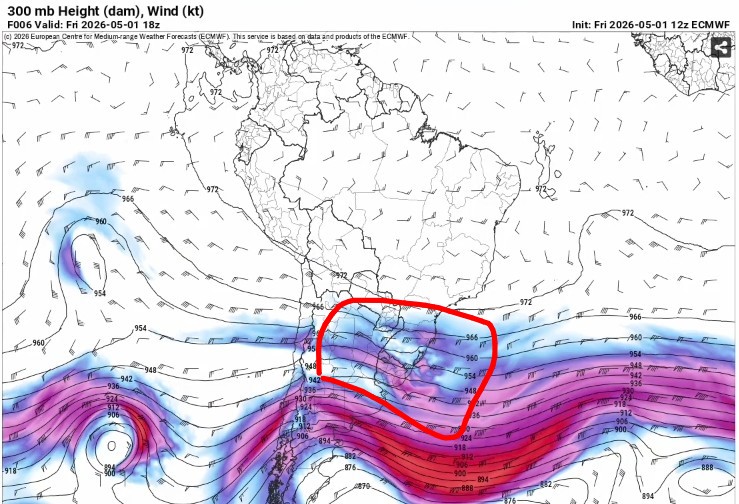
A series of jet streaks at 300 hPa developed downwind of the Andes, moving in a northwest-southeast and west-east direction, causing synoptic lifting through diffluence and intense activation of the South American Low-level Jet (hereinafter SALLJ) at low levels over the Argentina-Brazil-Uruguay tri-border region:


Initially, a tropical cyclone brought heavy rainfall in a short period of time, flash floods, and strong winds to the southernmost part of Brazil:

https://agorars.com/agora-no-tempo/chuva-passa-de-190-mm-e-causa-alagamentos-em-cidades-do-rs/

And later that night, a typical nocturnal intensification of the SALLJ—due to the stabilization of the PBL (planetary boundary layer) at higher altitudes—created conditions even more conducive to the formation of mesovortex tornadoes, as occurred in São Joaquim, Santa Catarina, Brazil, in the early morning hours of 05/02:

https://notiserrasc.com.br/tornado-e-confirmado-em-sao-joaquim-apos-temporal-na-madrugada/

[2/4]
 
Last edited:
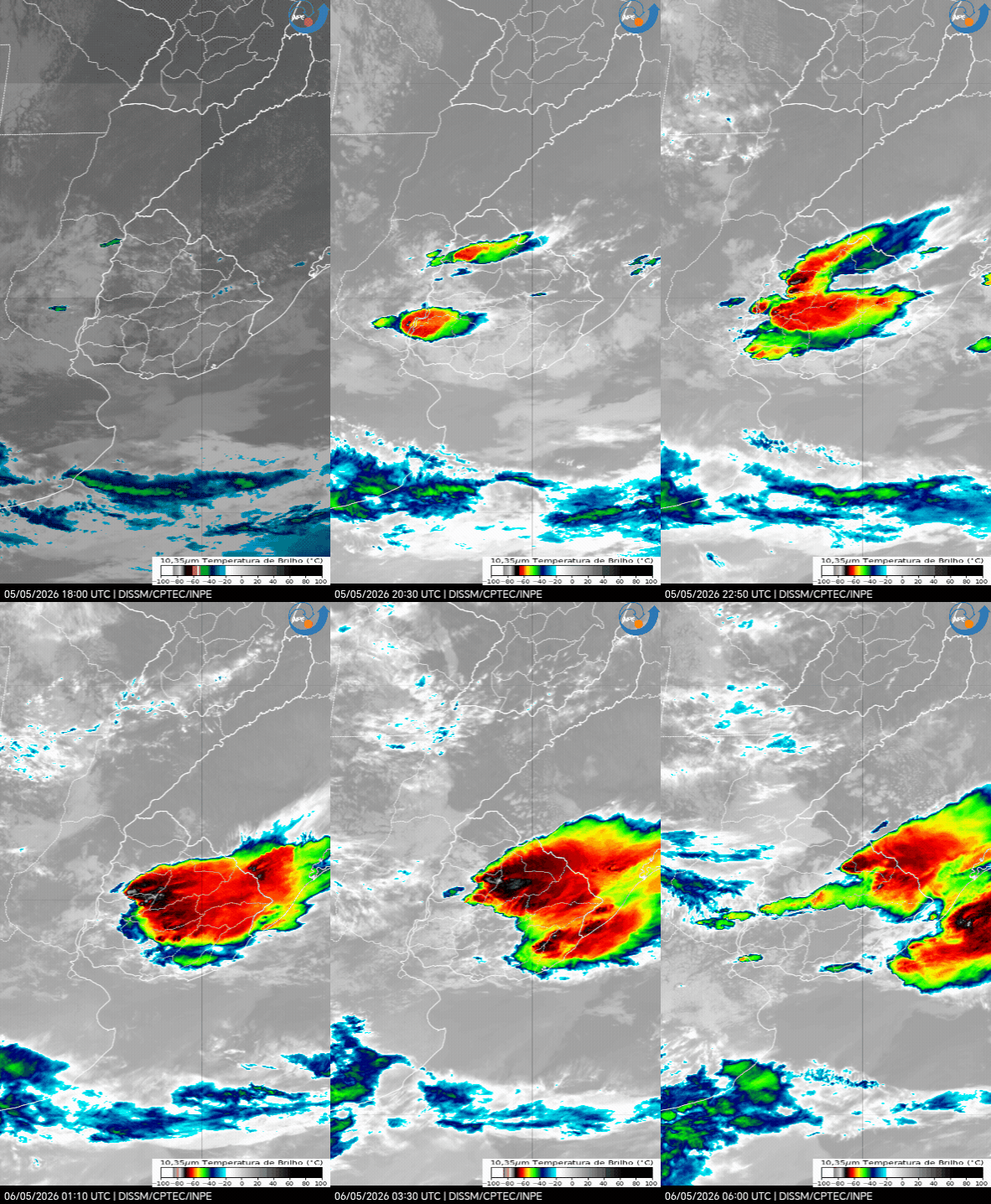
05/05/26

A short wave at 500 hPa embedded in the subtropical jet stream, driving the SALLJ toward its current position and triggering a brief outbreak of severe weather in Uruguay and along its eastern border with Argentina.

The most notable feature was this mothership supercell captured in Gualeguaychú, Argentina, near the border with Uruguay:

It is not yet known whether it produced a tornado, as it passed over a sparsely populated area after leaving the vicinity of Gualeguaychú, but there were certainly conditions conducive to big hail:


[3/4]
 
05/06/26

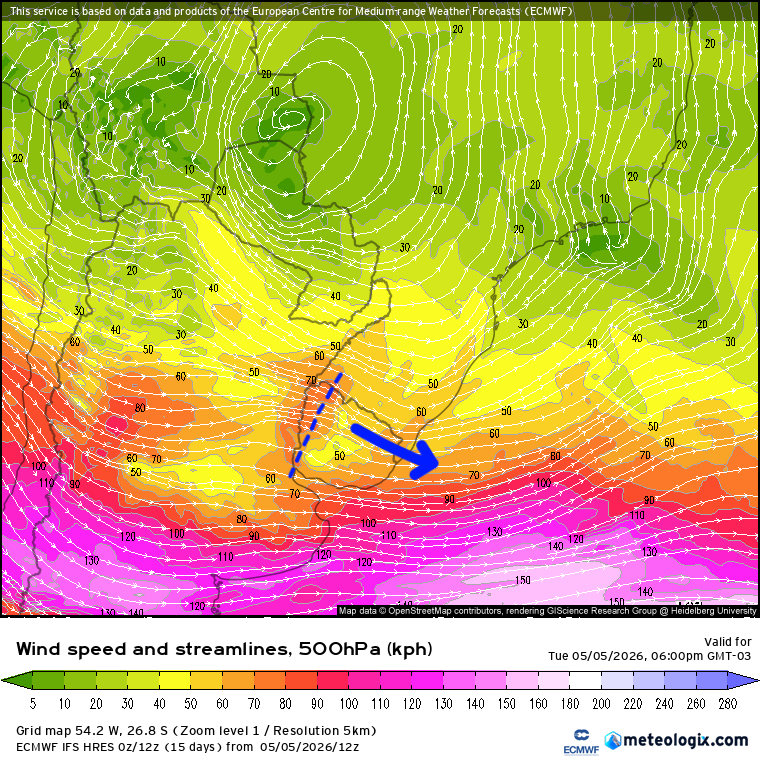
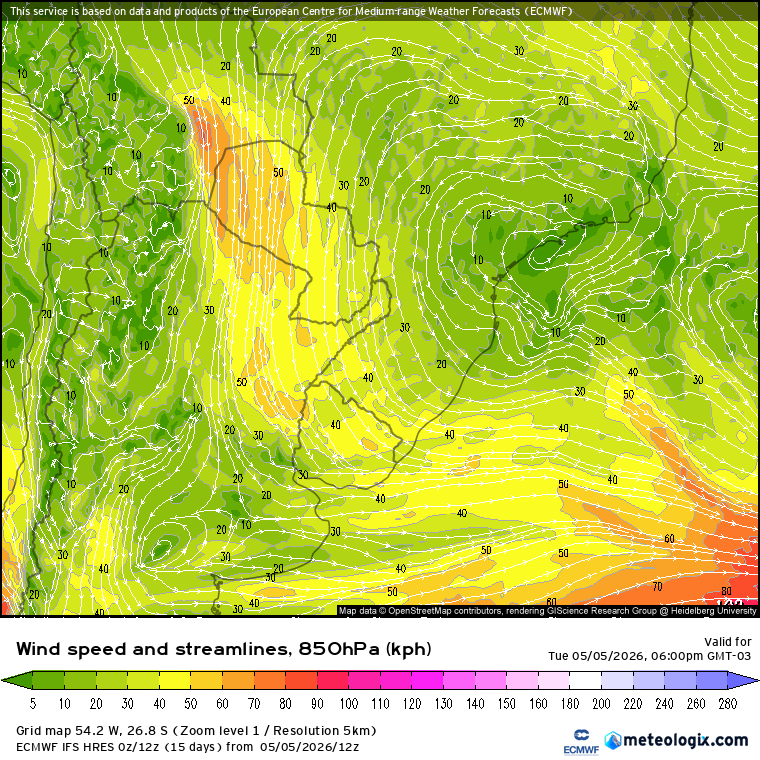
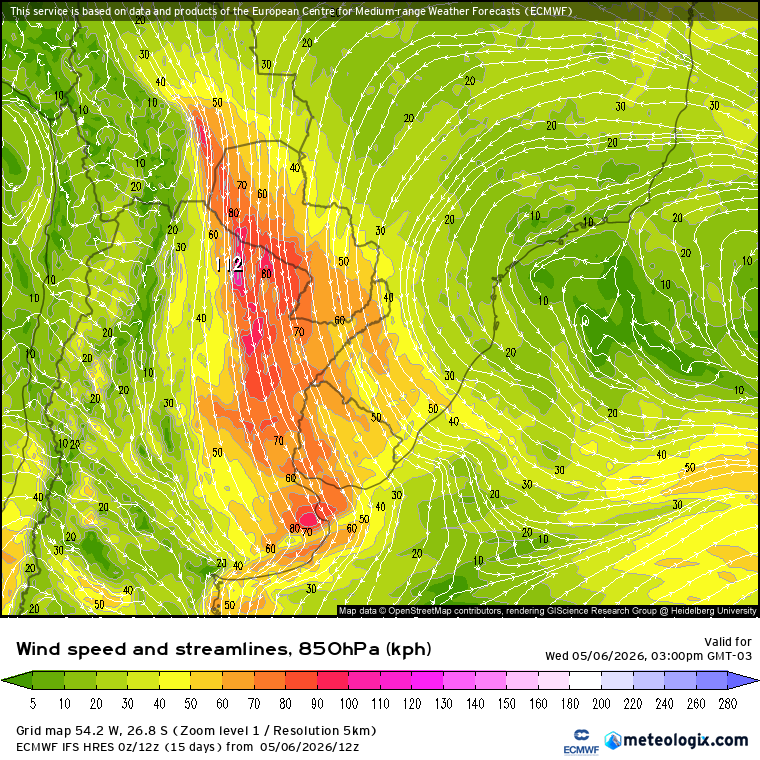
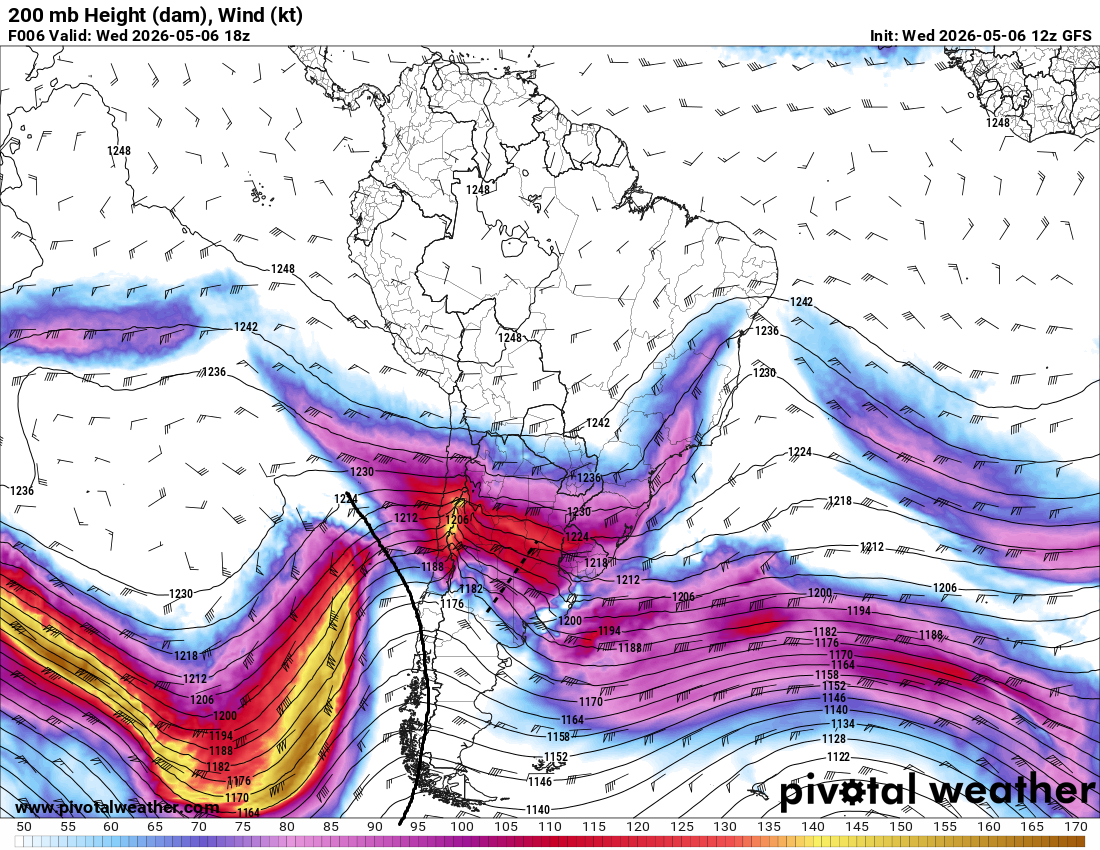
The left flank of a long-wave trough at 300–500 hPa, which had been moving across the South Pacific for days, was already crossing the Andes. Since this was a long wave, the response at lower levels would be the typical activation of the SALLJ downwind of the Andes, but this time it was much more intense and widespread, with winds of up to 90 km/h (50 kt) at 850 hPa, extending further south to central-eastern Argentina:
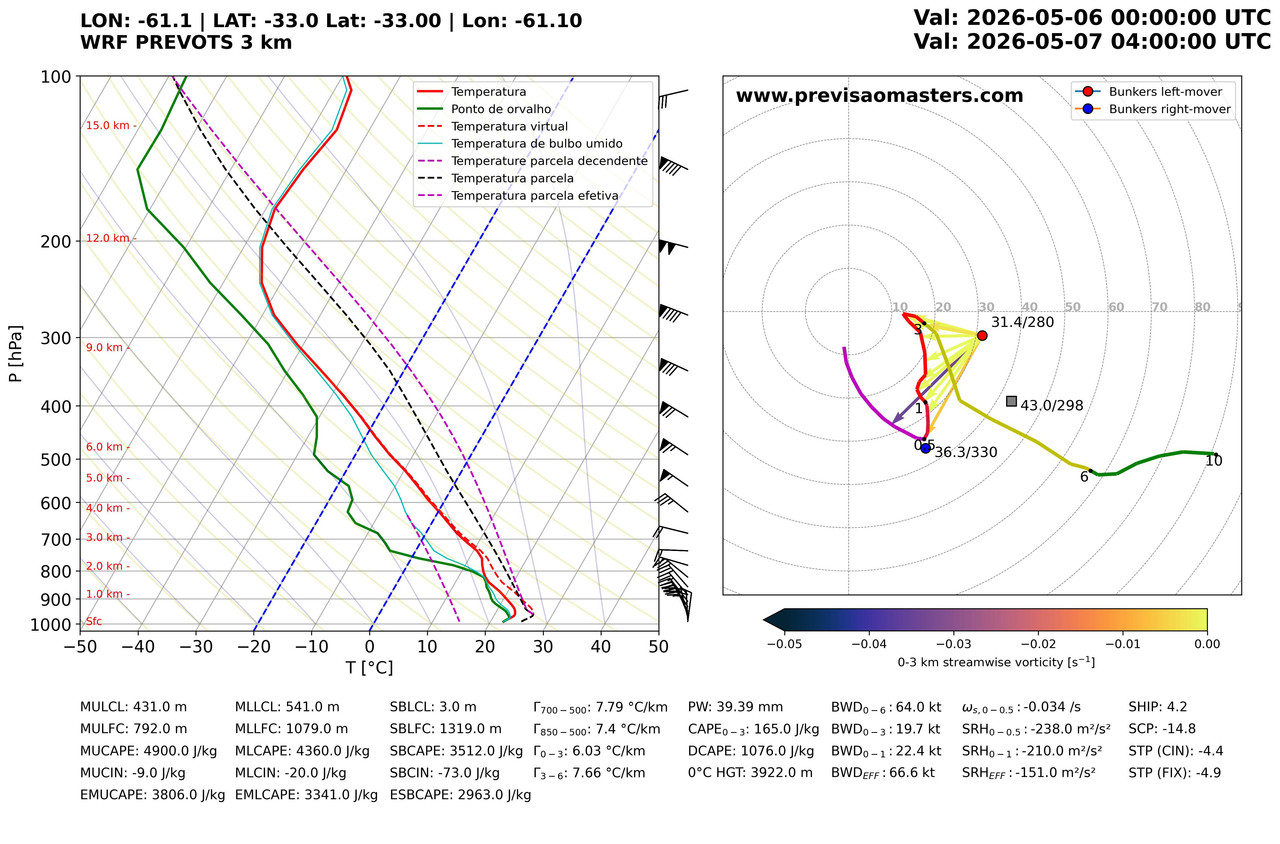
This created a highly tornadic environment for the Southern Hemisphere in the region, with strongly negative STP values that reached between -5 and -10:

That same afternoon, a subtle short-wave trough at 500 hPa developed on the leeward side of the Andes, passing directly over that region and embedded within the main northwest-southeast flow of the primary long-wave trough:
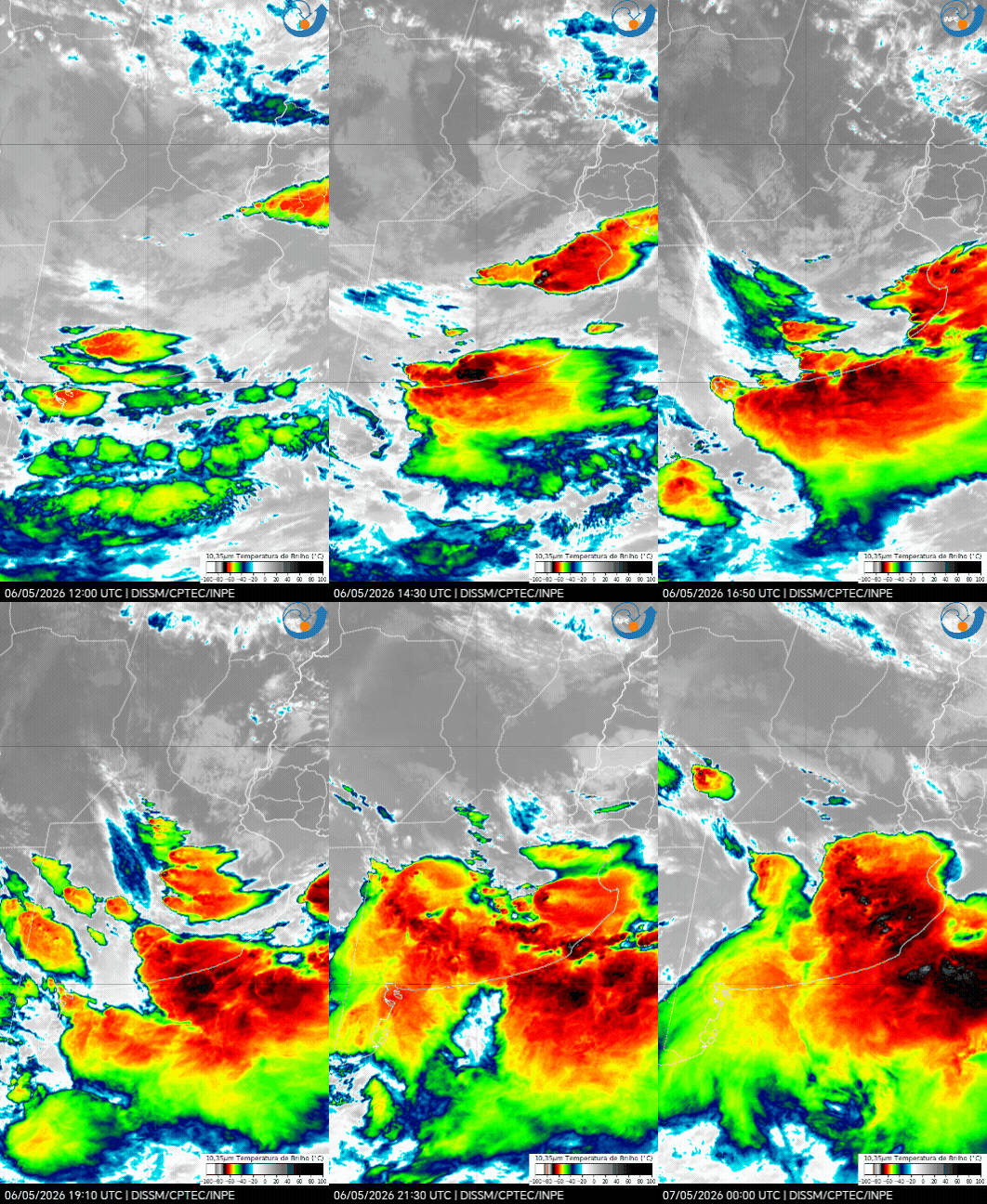
This marks the start of a series of discrete supercells across the province of Buenos Aires, bringing with them all the associated hazards, including microbursts and gorilla hail measuring ≥5 cm (≥2 in):


And, of course, tornadoes. At least one of these SCs managed to trigger a multi-vortex wedge tornado in the municipality of Las Flores, Buenos Aires:


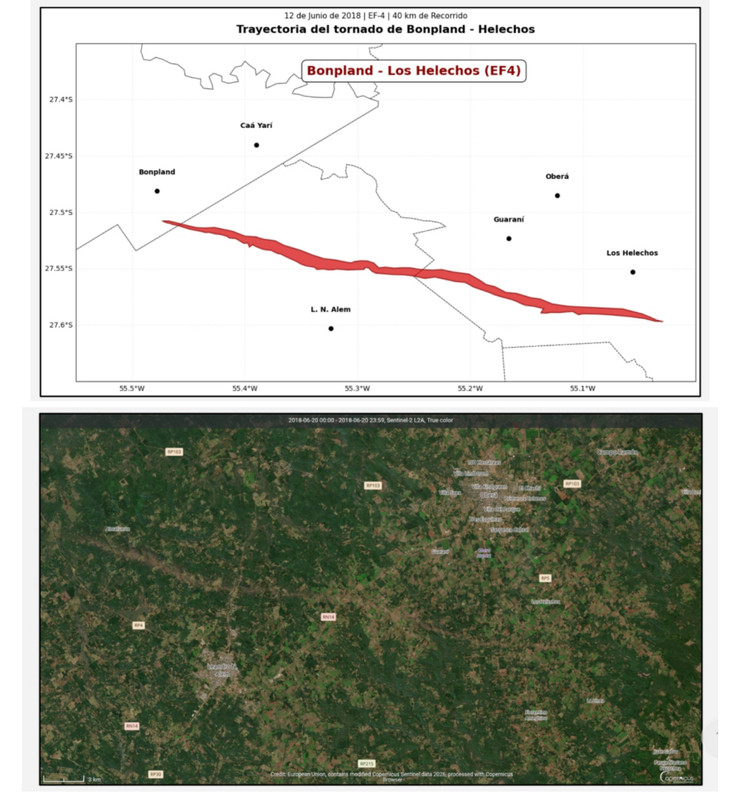
Unfortunately, no official agency has the resources or is currently conducting a serious investigation into the path of destruction and intensity of this tornado, but based on the videos and images circulating online, it is estimated to have been an F3 to F4 tornado. If the latter is confirmed, it could be the first vio-tor ≥F4 tornado recorded in Argentina since the nocturnal F4 tornado in Bonpland-Los Helechos, which struck the Argentine Panhandle on 06/12/2018.

[4/4]
 
Last edited:
Broyles trying his best to give chasers some hope with a Day 6 outlook for western/central OK/s-central KS/far n-central TX.
Large hail seems to be the main threat per the text but Broyles did say an isolated tornado could be possible. Still 6 days out, though, so who knows.
 
Large hail seems to be the main threat per the text but Broyles did say an isolated tornado could be possible. Still 6 days out, though, so who knows.

Right. Which is why I'm not a fan of using the day 4 and beyond highlight for that because to me it implies a decent level of confidence in a higher-ceiling threat, particularly involving tornadoes. Like don't introduce a 15% at Day 6 if it's just going to stay a 15% for hail/wind at Day 1. Just my opinion, though.

Probably stems from me being around when the Day 4-8 outlook was first made a public product in 2005. Back then it seemed to me like a rather obvious weakness for them to have nothing at all in their product suite to message to the public/EMAs/media beyond Day 3 when all the models were in lockstep agreement on a dangerous tornado outbreak on Day 4 or 5. So I was in favor of the product being launched for that reason, but I still think even in this day and age it should be used very cautiously for anything beyond that type of relatively rare scenario, especially the 30% highlight.
 
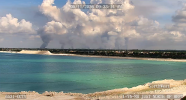
Unrelated but there is a very large wildfire ongoing W of Pembroke Pines, Florida.
1778507583308.png
Reflectivity has it a very short distance west of large suburban areas, although winds are NNE so I don't think much will be affected. The same camera had an absolutely insane view last night but the fire seems to have split up.
 
Last edited:
Unrelated but there is a very large wildfire ongoing W of Pembroke Pines, Florida.
View attachment 52739
Reflectivity has it a very short distance west of large suburban areas, although winds are NNE so I don't think much will be affected. The same camera had an absolutely insane view last night but the fire seems to have split up.
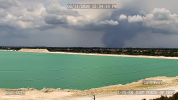
1778518532824.png
What a shot. If the clouds weren't so thin I could easily see this being a massive tornado.
 
Let’s steer things back onto the topic this thread was created for: this year’s severe weather.

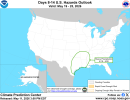
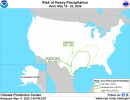
Beyond Saturday’s potential for hail/wind-related chicanery, are there any other potential signs of future severe weather that we should at least keep close eyes on?
 
Let’s steer things back onto the topic this thread was created for: this year’s severe weather.

Beyond Saturday’s potential for hail/wind-related chicanery, are there any other potential signs of future severe weather that we should at least keep close eyes on?
Thank you …
 

Attachments

  • hazards_d8_14_contours.png
    hazards_d8_14_contours.png
    939.2 KB · Views: 25
  • precip_probhazards_d8_14_contours (2).png
    precip_probhazards_d8_14_contours (2).png
    916.1 KB · Views: 28
Looks like we’re keeping this 5/19-5/20 tradition going. Biggest events are ofc the Moore EF5 and the 2019 High Risk day, not saying that’s what we’re gonna have, but definitely keep an eye out nonetheless.
 
I've finished my power trip. Now back to our regularly scheduled discussion.
 
With the way 2026 has gone so far, I wouldn't be surprised if it DID end up like the 5/20/19 High Risk.
Yeah 2026 has definitely been a strange year. Way too early to tell what it’ll do, but when I see high dew points, 2000-3000 cape, and a negatively tilted trough, it definitely gets my attention.
 
Back
Top