• Welcome to TalkWeather!
    We see you lurking around TalkWeather! Take the extra step and join us today to view attachments, see less ads and maybe even join the discussion.
    CLICK TO JOIN TALKWEATHER

Severe WX Severe Weather 4/11 - 4/15

Sharpy

Member
Messages
99
Reaction score
564
Location
United States
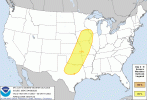
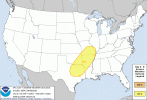
SPC has highlighted 3 days in their recent 4-8 day outlook across the South/central US. Starting this thread to hone in on these days.

Outlook from the horse’s mouth that is SPC and everyone’s favorite SPC forecaster in Broyles:

Day 4-8 Convective Outlook
NWS Storm Prediction Center Norman OK
0356 AM CDT Tue Apr 07 2026

Valid 101200Z - 151200Z

...DISCUSSION...
...Friday/Day 4 to Sunday/Day 6...
An upper-level trough will move eastward from the eastern Pacific on
Friday into the western U.S. on Saturday, as southwest mid-level
flow gradually strengthens over the south-central states. In
response, low-level moisture advection will continue over the Great
Plains. Ahead of the western U.S. trough, a subtle shortwave trough
is forecast to move into the southern High Plains Saturday
afternoon. A severe threat will be possible ahead of and near the
trough during the afternoon and evening.

On Sunday, the western U.S. upper-level trough is forecast to move
quickly east-northeastward into the southern Rockies. Ahead of the
trough, a moist and moderately unstable airmass is forecast over
much of the southern and central Plains by afternoon. Scattered
thunderstorms appear likely to develop over much of this airmass
during the afternoon and evening. Moderate to strong deep-layer
shear appear likely to be in place, which will be favorable for
severe storms. Supercells with large hail, severe wind gusts and a
tornado threat will be possible. An isolated severe threat may also
develop in parts of the north-central U.S.

...Monday/Day 7 and Tuesday/Day 8...
A secondary upper-level trough is forecast to move into the Desert
Southwest on Monday. Ahead of this system, a moist and unstable
airmass is forecast to remain in place from the southern Plains
north-northeastward into the Upper Midwest. Although a severe threat
will be possible along much of the instability corridor, the
greatest threat is expected to develop in the southern Plains, where
model forecasts show the most favorable environment.

On Tuesday, model forecasts have some agreement concerning the
timing of the trough, which is forecast to eject northeastward
across the southern and central Plains. Ahead of the trough, there
is large variance among the models concerning the distribution of
instability. If a moderately unstable airmass is in place by Tuesday
afternoon ahead of the ejecting system, a severe threat will be
likely from the southern Plains into the mid to upper Mississippi
Valley. However, the system will probably be slower than forecast,
which adds considerable uncertainty this late in the period.

..Broyles.. 04/07/2026
 
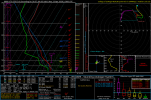
Keeping a close eye on Sunday/Monday myself. The 06z GFS has 450-500 SRH and about 430 Eff inflow with solid backing. Lapse rates don't look terrible either and there is a south-north dry line with decent gradient from Central OK through KS and into Nebraska, as well as shear vectors being perpendicular to said dryline, with soundings like this in SE Kansas:

1775571063027.png
 
Last edited:
So good news. I will be heading out early tomorrow morning and meeting up with Trey's tour in Oklahoma City for the rest of the duration, through Sunday. I plan to leave my vehicle at the airport so I should also be able to chase Monday on my way home.
 
So good news. I will be heading out early tomorrow morning and meeting up with Trey's tour in Oklahoma City for the rest of the duration, through Sunday. I plan to leave my vehicle at the airport so I should also be able to chase Monday on my way home.
Good luck , have fun and main thing stay safe ….
 
So good news. I will be heading out early tomorrow morning and meeting up with Trey's tour in Oklahoma City for the rest of the duration, through Sunday. I plan to leave my vehicle at the airport so I should also be able to chase Monday on my way home.
Get some beautiful pictures while you're at it!
 
The dewpoints (widespread 60s/70s) going into next week off the !2z GFS, Euro, Canadian, and Canadian Parallel favor a severe threat. Also, SPC hinted in their discussion this morning that the system could be slower than forecasted going into the next week timeframe. That, in turn, would allow for more moisture influx.
 
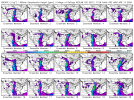
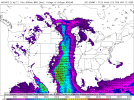
I thought this was interesting. Recently, the NCAR ensemble forecasts introduced Google's latest AI model, WeatherNext to their options.

Admittedly, its output is quite decently accurate!

I checked out GEFS ensembles for Sunday and there is actually a lot more variance than i thought regarding that day. Honing in on Thursday nicely, it seems.

predictions_grid_wxnext_mean_any_2026040700.png
 
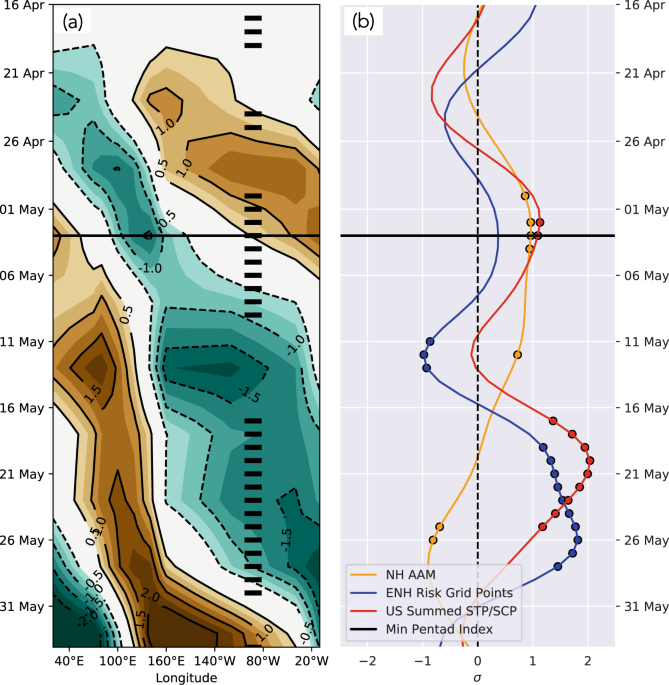
The blue line is April. Looks like we're screaming past phase 2 of the MJO spending only 3 days there. The average time to make it through all 8 phases is 30-60 days, so it's moving very rapidly.

View attachment 52605


What’s the TNI right now?

Admittedly, I’m aware of what the MJO is, but not specifically the phases. Do you have a quick rundown I can reference?

May be a quiet few weeks for Dixie judging by this tweet.
 
Okay. Some key things to note about that tweet:
1. you have a trough in the west which would yes mean increase in severe weather.
2. Subtropical jet increase=bowling ball lows riding along it.
3. Where's the SE ridge? That 588mb HP is located over Mexico not off the SE coast to Bermuda.
4. If you are going to have a subtropical jet increase, then you wouldn't have a SE ridge
So based on those 4 aspects, you would actually see a substantial increase in severe storm/tornado activity from the Southern Plains eastward into the Gulf States
 
What’s the TNI right now?

Admittedly, I’m aware of what the MJO is, but not specifically the phases. Do you have a quick rundown I can reference?

May be a quiet few weeks for Dixie judging by this tweet.
TNI is .51, so nothing crazy. The drop compared to last month is the result of rapid warming in the Nino 4 region.

I did a couple write ups on the MJO a little over a week ago. Some phases are more correlated with tornado activity than others.

Edit: Funnily enough, I wrote this first post 10 days ago, and the national blend of models had the MJO forecast to be where it currently is by April 31st. Safe to say we're way ahead of schedule. Not sure if there's any significance to that.

Doing some reading on the MJO and it appears Phases 7 and 8 are when the most tornadoes happen, but phase 2 is when the strongest tornadoes happen. We've been in 7 and 8, and we're heading towards phase 2 by the end of April.

View attachment 52339

Phase 2 shows enhanced violent tornado day (VTD) activity, with frequencies of 5.5% in March, 10.8% in April, and 12.5% in May. This enhancement is statistically significant during March-May.

View attachment 52340


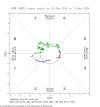
Here's a spaghetti plot of our current MJO and forecast over the next month. Looks like we're going to start April off in Phase 7 or 8, then potentially end the month in phase 1 or 2. Looks like late April and May could get extremely intense depending on the strength of the MJO. According to the study I'm reading, Phase 1 shows no statistically significant enhancement or reduction in VTD frequency compared to climatology. In fact, the document does not report any notable tornado activity anomalies for phase 1 across the various tornado metrics examined. The contrast is particularly striking when comparing phase 2 to other phases: VTD frequencies during phase 2 are substantially higher than any other phase

View attachment 52341

In conclusion, we could have an over average amount of tornadoes in early April, and transition to stronger tornadoes by the end of April and May

Went through my 100+ tornado outbreak sequence spreadsheet as well as the MJO archives, and found the phases each outbreak (from 1980-present) took place during.

View attachment 52350

Then I grabbed the list of all EF4 tornadoes from 2000-present and what phase those happened during. Phase 7 is just not a good time in general for tornadoes (weak or strong), so it looks like we might have a few weeks before activity potentially picks up again in the second week of April.

View attachment 52351

Based on my research, the sweet spot for violent tornadoes really seems to be right in this red circle. The strength of the MJO doesn't really seem to matter too much, but it does seem like activity usually occurres 2-4 weeks after peaks in strength, regardless of phase.

View attachment 52352


There is also research that suggests the strength and movement speed of the MJO can impact severe weather, but it seems less cut and dry to me, so I haven't posted anything about it. Here's the paper about it if you're curious, though.

 
Last edited:
There may be some uncertainty with trough placement, but damn if that isn't some solid agreement in terms of amount and location of SB CAPE. Widespread values of 2000+. The Euro is also in agreement about the amount and placement. I think we're going to need to see a lot more yellow (3000+) if this is going to be a prolific event.

1775612515692.png
1775617170982.png
 
There may be some uncertainty with trough placement, but damn if that isn't some solid agreement in terms of amount and location of SB CAPE. Widespread values of 2000+. The Euro is also in agreement about the amount and placement. I think we're going to need to see a lot more yellow (3000+) if this is going to be a prolific event.

View attachment 52607
View attachment 52608
You don't necessarily need 3k SBCAPE in the Plains this time of year to produce major outbreaks. All it takes is a nicely placed jet, allowing for winds aloft and if you have a sufficient LLJ, favorable ventilation and strong low level shear. Perpendicular to the dryline meaning discrete mode (as we have here)

You need at least 1.5k+ at minimum to produce those type of events.
 
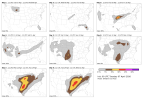
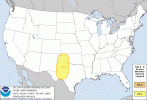
day4prob-1.gifday5prob-1.gif
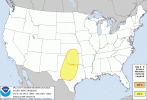
day6prob-2.gif
day7prob-2.gif

...DISCUSSION...
...Saturday/Day 4 to Monday/Day 6...
On Saturday, mid-level southwesterly flow will strengthen over the
central U.S., as an upper-level system moves to near the West Coast.
A moist airmass will be in place over the southern and central
Plains, as a low-amplitude shortwave trough moves across the region.
Large-scale ascent along with warming surface temperatures will
result in scattered thunderstorm development over much of west Texas
Saturday afternoon. MLCAPE is expected to peak near 1000 J/kg in
some areas, with 0-6 km shear being in the 30 to 40 knot range over
much of the southern High Plains. This should be sufficient for a
severe threat, with large hail and severe wind gusts possible.

From Saturday night into Sunday, strong moisture advection is
forecast over the Great Plains. By Sunday afternoon, moderate
instability is expected to be in place over much of this airmass.
Isolated to scattered severe thunderstorms are expected throughout
much of the moist sector during the afternoon and evening. Some
model forecasts move a 50 to 60 knot mid-level jet through central
and northeast Texas during the afternoon and evening. If this
happens, then a substantial severe threat would be possible from
parts of central and north Texas into Oklahoma. Severe storms,
including supercells with large hail, wind damage and a tornado
threat would be possible in areas that destabilize the most.

On Monday, a moist and unstable airmass is forecast to remain from
the southern Plains extending north-northeastward into the Upper
Midwest. Strong to severe thunderstorm development will be possible
over much of the instability corridor in the afternoon and evening.
The greatest potential for severe storms is forecast from the
southern Plains north-northeastward into the lower Missouri Valley
and upper Mississippi Valley, where the models develop moderate
instability and have 0-6 km shear mostly in the 30 to 40 knot range.
Severe storms with large hail, wind damage and a tornado threat will
be possible.

...Tuesday/Day 7 and Wednesday/Day 8...
The western U.S. trough is finally forecast to approach the southern
Plains on Tuesday, where a moist and unstable airmass should be in
place. Some solutions suggest that a mid-level jet will move into
the southern Plains Tuesday afternoon. This would create strong
deep-layer shear over parts of the moist sector, suggesting that a
substantial severe threat will be possible. Although there is still
spatial uncertainty regarding this scenario, current model forecasts
would support supercells with large hail, severe wind gusts and some
tornadoes.

On Wednesday, a shortwave trough is forecast to move through the
central states, with a southwest-to-northeast corridor of moderate
instability in place by afternoon from northeast Texas into western
Ozarks. This would be favorable for severe storms. However, at this
extended range, considerable uncertainty exists concerning severe
threat magnitude and spacing.
 
View attachment 52610View attachment 52611
View attachment 52612
View attachment 52613

...DISCUSSION...
...Saturday/Day 4 to Monday/Day 6...
On Saturday, mid-level southwesterly flow will strengthen over the
central U.S., as an upper-level system moves to near the West Coast.
A moist airmass will be in place over the southern and central
Plains, as a low-amplitude shortwave trough moves across the region.
Large-scale ascent along with warming surface temperatures will
result in scattered thunderstorm development over much of west Texas
Saturday afternoon. MLCAPE is expected to peak near 1000 J/kg in
some areas, with 0-6 km shear being in the 30 to 40 knot range over
much of the southern High Plains. This should be sufficient for a
severe threat, with large hail and severe wind gusts possible.

From Saturday night into Sunday, strong moisture advection is
forecast over the Great Plains. By Sunday afternoon, moderate
instability is expected to be in place over much of this airmass.
Isolated to scattered severe thunderstorms are expected throughout
much of the moist sector during the afternoon and evening. Some
model forecasts move a 50 to 60 knot mid-level jet through central
and northeast Texas during the afternoon and evening. If this
happens, then a substantial severe threat would be possible from
parts of central and north Texas into Oklahoma. Severe storms,
including supercells with large hail, wind damage and a tornado
threat would be possible in areas that destabilize the most.

On Monday, a moist and unstable airmass is forecast to remain from
the southern Plains extending north-northeastward into the Upper
Midwest. Strong to severe thunderstorm development will be possible
over much of the instability corridor in the afternoon and evening.
The greatest potential for severe storms is forecast from the
southern Plains north-northeastward into the lower Missouri Valley
and upper Mississippi Valley, where the models develop moderate
instability and have 0-6 km shear mostly in the 30 to 40 knot range.
Severe storms with large hail, wind damage and a tornado threat will
be possible.

...Tuesday/Day 7 and Wednesday/Day 8...
The western U.S. trough is finally forecast to approach the southern
Plains on Tuesday, where a moist and unstable airmass should be in
place. Some solutions suggest that a mid-level jet will move into
the southern Plains Tuesday afternoon. This would create strong
deep-layer shear over parts of the moist sector, suggesting that a
substantial severe threat will be possible. Although there is still
spatial uncertainty regarding this scenario, current model forecasts
would support supercells with large hail, severe wind gusts and some
tornadoes.

On Wednesday, a shortwave trough is forecast to move through the
central states, with a southwest-to-northeast corridor of moderate
instability in place by afternoon from northeast Texas into western
Ozarks. This would be favorable for severe storms. However, at this
extended range, considerable uncertainty exists concerning severe
threat magnitude and spacing.
Thats actually really strong wording for the D7 15%.
 
Back
Top